

Trees Part 2
July 15, 2026
For depth psychologist Carl Jung, the tree was a powerful image of the Self and of the soul’s long journey toward wholeness. He noticed that people often included trees in their mandalas and in other spontaneous images they created. To him, this suggested something important: the psyche was trying to gather its many scattered parts into one living whole.
The tree gives us a visible picture of this inner work.
Its roots reach down into darkness. They represent what is hidden from view—our shadow, our unconscious life, our buried memories, our fears, our instincts, our unclaimed gifts. And yet those same roots are also what ground the tree. They hold it steady in storm and drought. I have always found that fascinating: the shadow is not only what we fear in ourselves but also part of what grounds us. What lies beneath us may be darker than we wish, but it also gives us depth.
The trunk of the tree stands for the main timber of a life— our substance, our strength, our history, our endurance, the central meaning that holds us together. The branches reach outward toward light and sky, just as our lives reach outward toward relationship, purpose, beauty, and God. The leaves, flowers, and fruit represent what a life gives back: consciousness, fulfillment, kindness, wisdom, and love.
In this way, trees are not merely objects in the landscape. They are testimonials standing all around us. They are homilies in bark and leaf. They instruct us without speaking. They show us how to grow downward and upward at the same time. They teach us how to endure seasons, how to let go, how to begin again, how to stand still and yet be deeply alive.
And perhaps, if we are quiet enough, trees can become presences in our lives.
When I was a boy, there was one tree in our backyard that was very special to me. I loved the tall oaks and climbed them to heights that made my mother nervous, but none of them became my friend in the way our Mimosa tree did.
That huge Mimosa was already there when my parents built our house in 1955. They saved it when the land was cleared, and it became a living presence in our backyard. Because its lower limbs were easy to reach, I spent a great deal of time in that tree. About halfway up, one sturdy limb branched out into three, forming a perfect place to sit. I could settle there as if the tree had made that seat just for me.
Many hours of my childhood were spent in that place.
Being held by the Mimosa tree, I could have thoughts I could not tell anyone else. It supported me without comment, correction, or judgment. Sometimes I wondered about the tree. After all, it was much older than I was. It had been breathing there long before I ever arrived on this earth.
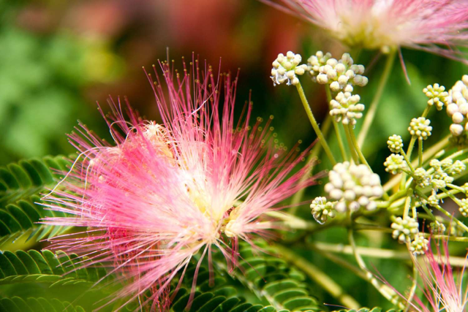
When I learned how, I nailed boards into that natural triangle of branches so I could lie up in the tree on my back and look upward through the fernlike leaves into the sky beyond. It was especially wonderful in early summer when the Mimosa bloomed. Its wispy blossoms looked like little bursts of pink and white feathers, and they gave off a sweet, almost intoxicating fragrance.
That tree had a soul.
I know that may sound strange to some, but I knew it then, and I know it now. It was a comforter. It was strong and able. It was a holder. It had compassion. I felt that compassion because it was an extension of home.
At twilight, something happened that I always looked forward to. My father was the one who first told me about it: the leaves of the Mimosa go to sleep at night. Each half of each tiny leaf folds together and closes. I loved knowing that. It made the tree seem even more alive to me, as if it had its own rhythms, its own rest, its own inner life.
When the blossoms died and fell to the ground, new growth appeared—long green pods filled with seeds. Later, when the pods turned brown and dry, they hung from the branches, and the breeze made them rattle like delicate wind chimes. In winter, the tree stood bare, but even then, its limbs held me. It was always there.
I was fifteen when the Mimosa had to be taken down for an addition to the house. I told no one, but I grieved that loss.
On a recent visit to that yard, I saw the place where the tree would have stood, now with even wider arms had it been allowed to live. My heart sank. That tree had been my friend from the summer before first grade until the tenth grade. I had never told anyone how deeply connected I was to it. I suppose I was afraid of being made fun of. By then, my ego had already learned to be wary of anything in me that seemed different.
But the child in me knew the truth: I had loved that tree, and that tree had been my friend in the only way a tree can love— by being steady, sheltering, fragrant, rooted, and present.
Today, I always notice Mimosas. Every year, I find one in bloom so I can stand close and breathe in its fragrance. That first whiff carries me instantly back into those three branches, back into the arms of that giant, compassionate friend. I am held again. I am accepted again. I am a child again, safe in the living world.
Some people have made fun of “tree huggers.” I never could.
Yesterday, on my walk with the dogs, I passed a blooming Mimosa in the park nearby. I stopped and took in the tree’s perfumed air. I reached for a blossom and picked it. Then, just as I did when I was a child, I twirled its wispy pink fibers against my cheek.
For me, the question is not simply, “What do trees mean?” It is “How does the tree know you and me?” What tree has held some part of your life? What tree has watched you grow, listened to your secrets, shaded your sorrow, or stood silently beside your becoming?
And if you were to draw the tree of your own life, what would it look like? Drawing a tree can be a spiritual practice, offering a different experience each time you draw it.
Would its roots go deep into the dark earth? Would its trunk be strong, scarred, twisted, or still growing? Would its branches reach wide toward others? Would there be blossoms? Fruit? Empty limbs? New shoots?
The tree may know more about us than we think. It may show us that wholeness is not perfection. Wholeness is roots and shadow, trunk and wound, branch and blossom, loss, and fragrance, all belonging to one living life.
Prayer
Dear God,
I am convinced that we humans and the animals are not alone on this planet. What you have created is a soul in everything. For having a tree teach me, listen to me, and hold me as a child and now, I am so thankful.
Amen