

Trees Part 1
July 14, 2026
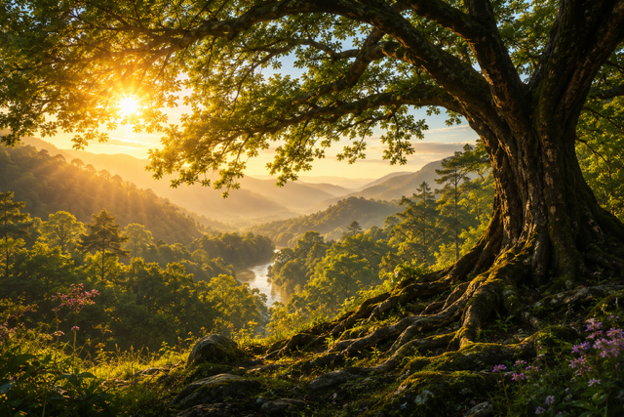
Welcome to this week's Daily Reflections on Trees.
In recent years, scientists and naturalists have begun looking more deeply into the lives of trees. How they grow, communicate, support one another, bear fruit, host countless forms of life, and eventually die. Why this growing fascination with trees?
I believe it is because we hunger for home.
Let me explain.
Long before cities, highways, and skyscrapers, when our ancestors lived among the trees, they found refuge, life, and their home there. Even those who dwelt in caves spent much of their lives in forests—hunting, gathering, climbing, and seeking safety beneath or in their canopy. Trees provided shelter, fuel, food, medicine, and protection. The story of humanity is inseparable from the story of the tree.
Because of this ancient relationship, trees have become an archetypal symbol of home, life, growth, shelter, and family. It is no accident that sacred trees appear in nearly every culture and religion. Deep within us, they evoke something familiar, something remembered.
As civilization left the forests behind, vast woodlands were sacrificed to build our homes, our industries, and our economies. Trees became less our companions and more our resources. In many places, they remain, but often as ornaments rather than necessities.
Yet something in us still longs for what we have lost. Though we may have distanced ourselves from the natural world, our deeper nature remembers. We may no longer depend upon trees for daily survival, but perhaps our souls still recognize them as kin.
The ego tends to view trees in practical terms. They provide lumber, shade, beauty, and cleaner air. They are useful. They have value. But the ego often places greater value on growth of another kind—economic growth, expansion, and acquisition. These functions are important, but must they leave the soul’s value of nature behind?
The soul sees differently. It recognizes a tree not merely as an object, but as a living presence. It sees a forest not as a collection of individual trees, but as a community. Modern science increasingly confirms what indigenous peoples and mystics have long understood: trees exist in relationship. They share resources, communicate through intricate underground networks, and take part in a remarkable reciprocity with one another.
In this way, forests become mirrors of ourselves. They remind us that life is sustained not by isolation but by connection. They teach us that strength and interdependence are not opposites. They reveal that thriving comes not only from competition, but from cooperation.
Perhaps our attraction to trees is really a longing for what they represent. We yearn for rootedness in a restless world. We long for belonging in a culture that often prizes individualism and breeds loneliness. We long for safety and connection… We long to be seen and to be loved. All these are also characteristics of home. Deep down we seek reconnection with nature, with one another, and with the deeper Self that remembers who we are.
The soul seeks a home larger than any house—a home within the living web of creation itself. And perhaps that is why we are becoming more fascinated with and drawn to trees. They are living monuments to our life’s process of growing, thriving, and then disappearing, only to have a shoot rise in its place. Standing beneath their branches, we hear something ancient within us whisper, “Remember? You belong here— you are part of every living thing.”
Spiritual Practice
You guessed it; try spending a day in the woods— even half a day. Take your journal and record what you feel and experience. Write an entry as the voice of your soul.
Inquiry
What is your earliest memory of a tree? What would you say to that tree now, as your soul child?
Prayer
Dear God,
Walk with me into the woods — walk home with me.
Amen