The Parade Part 4
March 18, 2026
The Parade Part 4
Not all parades celebrate victory or joy. Some parades expose the darkest capacities of the human soul.
The 2025 historical drama “Nuremberg,” written and directed by James Vanderbilt and based on Jack El-Hai’s The Nazi and the Psychiatrist, draws us into one such parade. The riveting film centers on the psychological duel between U.S. Army psychiatrist Douglas Kelley (Rami Malek) and Hermann Göring, Hitler’s second in command (Russell Crowe), during the 1946 Nuremberg Trials.
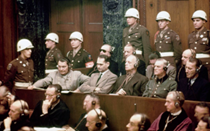
In its broader scope, Nuremberg recounts the prosecution and sentencing of Göring and twenty-three other top Nazi leaders, judged as war criminals by an international tribunal. Justice, long delayed, was finally being rendered, but not without first exposing the world to the depth of what these war criminals had done.
During the trials, each morning, Göring and the other prisoners were paraded under armed guard from their prison to the courtroom next door. The movie portrayed their walking through a hastily constructed, covered corridor, only a narrow passage of thin wooden boards separating them from the outside world. As they moved along, crowds gathered beyond the walls, pounding the boards with fists and fury, expressing their rage toward the men who had led a war of domination and orchestrated the extermination of more than six million people.
It was a grim parade. No music. No celebration. Only the slow procession of human beings carrying vastly different inner states: some humbled, some terrified, some clinging to defiance. Göring walked with an air of superiority, as though he remained above judgment, untouched by the suffering he had helped unleash. This parade, then, was one of emotions, some from the false self, others from abject unobscured fear.
The emotional climax of the trial came when the courtroom was shown documentary films of the Nazi atrocities. Sixteen- and thirty-five-millimeter footage, taken by liberating armies and the international press, revealed the unspeakable: mass graves, emaciated bodies, murdered children, women, and men, gas chambers and ovens that incinerated as many as 400 bodies in any given day. The world watched in stunned horror as undeniable evidence of intentional, systematic slaughter filled the screen. Nothing could prevent the grief and revulsion these images provoked.
Afterward, Göring took the witness stand. He deftly sidestepped responsibility for what was chillingly called “The Final Solution.” The film reveals an underlying truth: the Third Reich projected its own hunger for superiority onto the Jews, transforming them into scapegoats. What we now call white supremacy found deadly expression as policy. Once the Jews were declared the enemy, no moral boundary remained; anyone with three or more Jewish grandparents was marked for eradication.
Near the end of his testimony, Göring declared that he would follow his Führer, his embodiment of absolute authority, all over again. He ended his self-defense with a loud, defiant cry: “Heil Hitler!”
Nuremberg is not merely a historical account; it is a warning. These events, the film insists, are not confined to Germany or to the past. They can happen anywhere, even in the United States of America. Fundamentally decent people, if unalert, can be manipulated by leaders who sow fear, hatred, and division. Tyranny is often insidious and nourished by denial and silence. When good people fail to resist evil, they paradoxically become part of it.
The film makes clear that the narcissistic drive for domination is not a national trait but a human one. Just beneath the surface, in every culture, are individuals who, once given power and the support of a compliant crowd, would destroy whatever stands in the way of their supremacy, even if it requires the slaughter of innocent children and their families.
As the film concludes, a final quotation fills the screen:
“The only clue to what man can do is what man has done.”
—R. G. Collingwood, The Idea of History (1946)
That quotation, which also alludes to the tremendous potential of humanity, sobers us. It brings us to the parade of humanity, made up of evil, goodness, and everything in between. The parade of elite prisoners each morning in Nuremberg was a parade of shame as well as utter shamelessness. The pounding fists on wooden boards could not put a dent in the hubris of those who, detached from their souls, took delight in the torture and deaths of innocents. The parade at Nuremberg reminds us that history is not safely behind us, but rather, is always marching nearby. You and I will determine what the next parade will look like.
Self inquiry: What would lead someone to deny the holocaust despite the overwhelming evidence that it occurred?
Prayer:
Dear God, Make me an instrument of your peace. Amen
St. Francis of Assisi