Personality Part 2
May 13, 2026
Personality Part 2
Many of us find ourselves captivated by the Enneagram—its uncanny ability to describe, with startling accuracy, the patterns of human personality. Across cultures and countries, its influence continues to spread. Why? Because it speaks to something we continuously seek to understand ourselves and also to know what makes others tick.
One of the Enneagram’s great gifts is its clarity. It reveals both our strengths and our blind spots. Again and again, people encounter a surprising recognition: “I thought I was the only one who felt this way… who reacted this way… who got stuck in the same patterns.” The Enneagram gently dismantles that illusion. It shows us not only what we do, but why we do it, and how we repeatedly find ourselves cornered by the same inner habits, unsure how we got there or how to break free.
Our fascination runs deeper than curiosity. We want to know how we are “wired.” We want to understand why certain traits seem to help us flourish while others quietly sabotage our peace. Some approach the Enneagram to refine their identity—to add another layer to the story they tell about themselves. Others are drawn to the idea of integration, seeking the qualities that might heal what feels fragmented within. And many simply long for greater awareness—because even a modest understanding of personality can transform relationships, reduce anxiety, and open the door to wiser living.
At the surface level, the Enneagram names our personality patterns, the roles we may recognize in ourselves: the achiever, the helper, the thinker, the peacemaker, the reformer. These patterns can be useful. They give language to our tendencies and highlight both our growth and our decline.
But the Enneagram was never meant to stop there. In its deepest purpose, it points beyond personality. It reminds us that we are not the mask we wear, not the strategies we’ve learned, not the defenses we’ve built. We study personality not to perfect it, but to see through it. And beyond it, something far greater begins to emerge.
I call it soulality—the deeper, truer essence of who we are. Soulality is much more than personality; it is the ability to live from soul and to project that energy outward through our personality. Yes, beneath the protective layers of personality lies the soul: not exhausted, not fragmented, not driven by fear. The soul is pure essence, a part of the Great Essence to which we are tethered. It is steady. It is alive with a quiet, inexhaustible energy because it is rooted in the Divine. Where personality contracts, the soul expands. Where personality performs, the soul simply is.
The Enneagram offers a subtle but powerful bridge to this deeper self. Each personality type carries within it what is sometimes called a “Holy Idea”—a truth placed in us at our making that has been obscured but never lost. When we begin to see this truth clearly, it gently guides us beyond our habitual patterns and toward the qualities of the soul that have always been present, yet hidden.
In this sense, the Enneagram is not merely a map of personality—it is a path of return. It echoes a timeless truth expressed in Bible: “The one who is in you is greater than the one who is in the world” (1 John 4:4).
This is the quiet promise at the heart of the journey: that beneath everything we have learned to be, there remains something unshaken, something luminous, something that has access to the Divine. And when we begin to live from that place, life does not become easier, but truer. Fuller. More deeply aligned with who we were created to be.
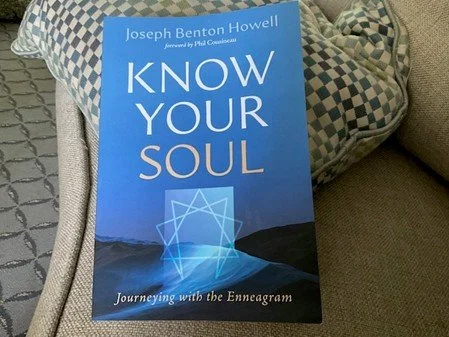
Spiritual practice: Read Chapter Six of Know Your Soul, page 137. Journal your thoughts about your divine qualities.
Self-inquiry: Am I more intrigued with my personality—or with my soul?
Prayer:
Dear God, Lead me back to my true nature—my soul. Teach me to live from that deeper place, even when it feels unfamiliar. I know this path carries responsibility, but I also trust it holds the only lasting peace. Amen.