You Live and Learn Part 7
December 8, 2025
You Live and Learn Part 7
Seeing a child’s eyes light up is a wonderful experience. When they finally understand something, grasp a concept, have an insight, or finally see what was hidden, they are a step closer to reaching the fullness of their life. For me, their most touching Ah Ha’s are those of the heart.
In childhood, we develop empathy, compassion for others, and expand our natural capacity for joy. We also learn how to recognize and modulate our negative emotions. When a child experiences a trauma, their emotions are in turmoil. The trauma may be from immense struggles such as significant loss, an accident, bullying, or a myriad of life-altering circumstances. Some children struggle to understand the emotions associated with their experiences and may act out their feelings at home and at school.
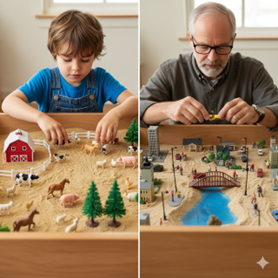
One of the most effective ways to help children learn about and manage their emotions is through play therapy. Therapists invite the child to play with various toys and objects while verbally interpreting their play with the toys. Child’s play covers a wide spectrum. They may role play with various toy characters, engage in a fight with action figures, throw toys, or create something with paper and colors. When they finish the therapeutic play, they have a much clearer understanding of what is going on inside themselves, because the therapist helps the child come to terms with their emotions. Then a plan can be made for how to deal with those emotions.
Play facilitates the expression of the total range of emotions. For example, the child may carefully build a tower of blocks only to knock it down. This is when the therapist mirrors the emotions by saying things like, “Wow, it took a lot of strength to knock down the tower you took so much time to build— could you be a little angry?” Or a child may use stuffed animals and invite them to their birthday party, or wear costumes to play dress-up. The therapist may say, “It’s nice to be invited; are you asked to the party, or are you left out?” Play therapy is also diagnostic. For example, the child may use dolls or action figures to reveal abuse going on at home, tension in the household, or a problem at school.
Adults can also benefit from play therapy. Developed from Carl Jung’s concept of Active Imagination, a technique called sand tray or sand play helps clients work through unconscious and conscious emotional issues. The client chooses “toys” from a wide assortment and creates a landscape in the sand. On the landscape, they may fashion such things as a pond, a little town, bridges and roads, a family unit with or without extended family, a volcano, people on a desert island, or two continents with an ocean in between. Most sand trays end up filled with toy buildings, people, structures, and the like. The things the client creates are limited only by their imagination.
But it doesn’t end with the play. Like children do, the adult client acts out a story around what they build, as they “play” with their “toys” to make their story unfold. The therapist remains non-directive, delaying interpretation to allow the client to gain their own insight over time. Some therapists make interpretations and observations as the play unfolds. Sand play for adults can be done without a therapist.
We do not outgrow the need for play. To pretend, to imagine and to make believe, brings life and helps redirect dammed-up energies. When the creative juices flow, we are less trapped in our compulsive ways of thinking and doing—we become open to other, far more productive and healthy avenues.
Spiritual practice: Do you have a conundrum or a trap for which there is no apparent solution? Use active imagination to open yourself to new possibilities. Even if you have to imagine a far-fetched solution that would never work, let yourself “play” with that impossibility. By entertaining it, we give our creative mind the OK for other, more practical solutions to emerge. If you are industrious, let yourself play with some toys and pretend that they represent things and people in your life. Without self-judgment or the inner critic, invite yourself to play out a story and see what unfolds.
Self-inquiry: Do you miss playing as you did when you were a child? Why so, or why not?
Prayer:
Dear God, I ask you for healing through creativity. Let me imagine all the things that free me from ruts, compulsions, and unimaginative sameness. Amen