Inner Strength Part 2
May 6, 2026
Inner Strength Part 2
In consciousness and spirituality studies, there is a common denominator: the quest for peace. In such studies, all forms of peace can be traced back to the great peace extended to the universe, from beyond ourselves—the peace of the Divine.
We frequently associate peace with being stationary, at rest, relaxed and even in a meditative state. We may get the idea that complete peace is non-movement. But this is not always the case.
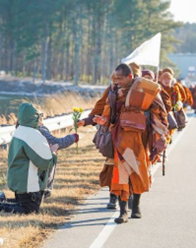
The name “peace activist” may seem like an oxymoron, but in reality, it perfectly names peace as an active state requiring endurance and inner strength. The more we come across issues which need healing or solutions, the more we require active peace.
When something is wrong in ourselves, our family, the community, or the world, it is easy to jump the gun out of fear, anger, or sheer efficiency. Knee-jerk reactions solve the problem temporarily but oftentimes they make matters worse.
But if we come from a base of active peace, we respond with poise, with a relaxed knowing that “all shall be well,” without dividing everything into good or bad. We step in and, with words and actions, calm tensions and seek reconciliation within ourselves or in the outer circumstance.
But to actually be active, peace takes inner strength. To harness and redirect the “shoot from the hip energy” into a positive and grounded response, takes huge amounts of soul strength. For the solution to appear, it takes a power beyond us — a power so great that the soul overwhelms the ego’s will. And then the ego has the choice to submit to and serve this power. This requires an inner strength that says to us, “Regardless of the time and effort it takes, I will be proactive in achieving a peaceful settlement for all concerned.” This is when peace and strength join forces.
When we are driven solely by the unchecked strivings of the ego, it can lead to neurological turmoil. Our limbic system and the pineal gland, all in the center of our brain, conduct our emotions throughout the nervous system. They can be in a state of agitation and raw turmoil if we are off kilter, upset, sad, angry, over extended, fearful, or agitated, etc. But living in a meditative state relaxes those neurons and glands so they can more readily access our inner strength. From inner strength comes deep peace; from deep peace comes peaceful action.
One human being among many who embodied active peace and taught others its power was Mahatma Gandhi. He dared to lead an entire society to push out the British Empire from India. Under his leadership, not one violent act, only peaceful resistance, took down the British Empire’s rule. The strength and power that Gandhi was in touch with taught the world a profound lesson: Love can conquer terror. This power can be harnessed not only for collective cultural changes such as those brought about by Gandhi, but for our own individual inner conflicts. Instead of waging inner violence on ourselves, we can enact peaceful resistance and free ourselves from the ruling empire of the inner critic, the passions, and the fixations.
Spiritual practice: Breathe in deeply through your left nostril and exhale through your right nostril ten times. This method is an ancient spiritual meditative technique that brings peace quickly to the inner cortex. Does it work for you?
Self-inquiry: Why would I not consider that my body keeps score? Why would I consider self-forgiveness for past actions that cause present issues with my body?
Prayer:
Dear God, I know the feeling of constant, raw agitation. It makes me lose control far too quickly. I pray for your strength so that I may live knowing that “all is well.” Amen.