First Things First Part 3
July 30, 2026
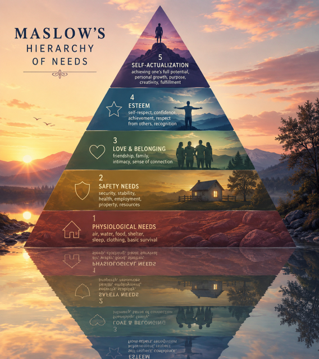
According to psychologist Abraham Maslow, our first and most basic needs are physical: food, water, clothing, rest, and shelter. Then comes our need for safety. After that comes our need for love and belonging, followed by our need for self-esteem. At the top of his hierarchy is self-actualization— the process of becoming the person we were created to become.
Maslow’s theory suggests that we cannot give full attention to the higher needs until the more basic ones are reasonably met. It is hard to think about purpose when we are hungry. It is hard to feel secure when we are afraid. It is hard to grow into our fullest self when we do not feel loved, wanted, or worthy.
Self-actualization is often described as the unfolding of our unique gifts, talents, capacities, and purpose. For those who live the spiritual life, this growth is not only psychological. It is also the growth of the soul. It is the deepening of love, compassion, courage, gratitude, wisdom, and truthfulness. It is becoming more fully the human being God created us to be.
So, in one sense, there is an order to growth. First things do come first. We need food and water. We need shelter and safety. We need love and belonging. We need a sense that our life has worth. These are not small things. They are not beneath the spiritual life. They are part of the spiritual life.
But real life is not always as neat as a ladder.
Many of our deepest spiritual awakenings come when one of these basic needs is threatened or missing. Sometimes the lack of safety teaches us courage. Sometimes loneliness awakens our longing for God. Sometimes failure humbles us enough to receive grace. Sometimes illness, loss, or uncertainty opens a depth in us we did not know was there.
This does not mean suffering is good in itself. Nor does it mean that people should be deprived in order to grow. It simply means that the soul is mysterious. Even in the lower levels of need, seeds of higher growth may already be present.
Life does not allow us to graduate permanently from one level to the next. Even if we have touched deep spiritual insight, we still need breakfast. We still need sleep. We still need to feel safe. We still need friendship. We still need encouragement. We still need to know that our lives matter.
To be spiritually mature does not mean we no longer have ordinary human needs. It means we bring a deeper consciousness to them.
When we are hungry, we may become more grateful for bread. When we are afraid, we may learn to seek shelter without shame. When we are lonely, we may reach out rather than shut down. When our self-worth is shaken, we may remember that our value does not depend on achievement, approval, or control.
The needs of daily life are not obstacles to spiritual growth. They are the raw material of it. They are the ground on which the soul learns humility, dependence, love, patience, and trust.
The beauty of spiritual growth is that once we have reached a higher level of consciousness, we do not completely lose it when we must return to basic needs. Something of that higher awareness comes with us. The soul remembers.
So, when life brings us back to first things— food, safety, love, belonging, worth—we do not have to see this as failure. We can see it as another place where God meets us.
The phrase “First things first” does not mean lower things are less holy…they may be even more holy at times.
It may mean that the most ordinary needs of our lives are the very doorway through which the soul continues to grow.
Spiritual Practice
Write down the needs you are supporting at this time. As you look at the Hierarchy of Needs, where do you find yourself?
Inquiry
Today, what is your greatest need?
Prayer
Dear God,
I pray for insight into my needs and how they lead me to self-knowledge and then, closeness to you.
Amen