

First Things First Part 4
July 31, 2026
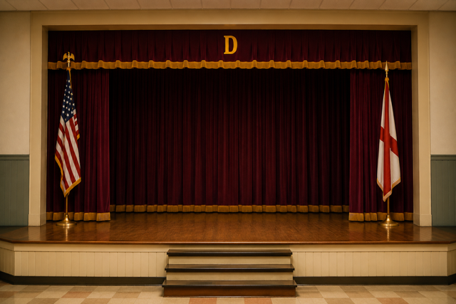
Once, as a young adult, I revisited my grammar school— E.R. Dickson Elementary in Mobile, Alabama. It was just as I had remembered it, all in living color! The smell of freshly waxed hallways, the murmuring voices of children in their classrooms, and the aroma of food wafting from the cafeteria. That day, everything came back to me like scenes from an old movie reel. After walking the hallways, I entered the cafeteria, which was also used for school plays and assemblies, and was struck by how much smaller everything was than it had seemed when I was a child.
Then I walked onto the stage. It had the same burgundy drapes and gold fringe, as in yesteryear, and as soon as I stepped onto it, a memory flooded my mind—one I had rarely thought about, but one that had stayed hidden inside me under the name of shame.
When I was in the fourth grade, our school secretary, Mrs. Smith, retired. For some reason, I was chosen to present her with a retirement gift during a ceremony in front of the whole school. My mother helped me write the speech. I remember almost nothing about it except one line: “We present you with this gift because as the school’s secretary, Mrs. Smith, you have gone above and beyond the call of duty.”
I had never stood before a crowd before, much less the entire school. I memorized my lines and waited for the big day with all the nervousness a child can carry. Finally, the day came. There I was on stage, holding the gift in my hands, speaking into a microphone, standing before the honored guest with Mrs. Smith’s corsage pinned proudly to her dress.
As far as I can remember, the speech went fairly well. But then something happened that I never forgot. After I finished speaking, I walked off the stage—still holding her gift in my hands. Out of nowhere, a crusty teacher yelled in a booming voice, “You forgot to give her the present!” I was mortified. I had been so focused on getting my speech right, so overwhelmed by being on stage in front of everyone, that I forgot the very reason I was there. I had remembered my words but forgotten the gift.
Quickly, I trudged back onto the stage and handed the nicely wrapped present to the guest of honor.
For years, I carried that memory as shame. I did not realize until reflecting on it now that I had stored it away in that category. The child in me had learned a painful lesson: when you forget “first things first,” there may be a price to pay. My young ego felt exposed, belittled, and corrected in front of everyone.
But something different is happening as I reflect on it today.
Now I can see that child with compassion. He was not a failure. He was not careless. He was a little boy trying to do something he had never done before. He was excited, afraid, dutiful, and overwhelmed. He was trying to remember his words. He was trying to be good. He was trying to do what the grown-ups expected of him. And in all of that, he forgot the gift.
If I were in the audience today and saw a child do the same thing, I would not shame him. I would smile with tenderness and think, “Isn’t that true of all of us? We can become so absorbed in performing correctly that we forget the gift we came to give.” We forget the point. We remember the speech but forget the offering. We remember the performance but forget the love. We remember how we are being seen but forget what we are here to give.
This is one of the ways childhood shame keeps reaching us long after the event is over. It convinces us that our mistake revealed something wrong with us. But spiritual consciousness invites us to look again. It asks us to revisit the scenes of yesterday with wiser eyes. It helps us see not only what happened, but who we were when it happened.
And now I see a child who needed mercy. So, instead of cringing with disgust about what I did, I offer myself a little grace— grace enough to change the electrical charge of this memory from shame to self-compassion.
Spiritual growth does not erase our old memories. It transforms the way we hold them. What was once a wound can become a doorway. What was once shame can become compassion. What was once a memory of humiliation can become a lesson in tenderness. For me, “first things first” does not only mean remembering the performance but remembering the soul behind it.
Before judgment, mercy.
Before shame, compassion.
Before correction, love.
Spiritual Practice
Do you have a memory of shame that still lives somewhere inside you? Can you revisit that memory now—not as the wounded child alone, but as the compassionate adult who can finally stand beside that child with mercy?
Inquiry
Why is it often easier to offer compassion to others than to offer it to ourselves?
Prayer
Dear God,
In your mercy, I rename this experience from “Shameful” to “Opportunity for self-compassion.”
Amen