

Enchantment Part 5
October 15, 2026
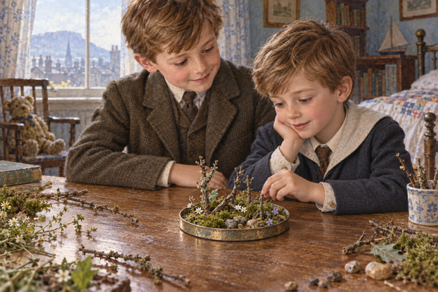
At about ten years old, childhood innocence was already beginning to wear away for me. I straddled the enchantment of being a soul child and the growing expectations of becoming a responsible young man.
During this season of my life, our family visited my aunt and uncle at their country home, about three hundred miles north of us. They lived across a dirt road from a farm, complete with cornfields, a barn, cows, and tractors.
There was much love between our two families. One of their sons, my cousin, a year older than me, and I always enjoyed playing together. During that two- or three-day visit, he and I ventured onto the farm. We patted the cows, looked into their big brown eyes, walked through the tall corn, threw rocks into the small pond, and climbed on the tractor seats inside the old wooden barn and pretended to drive the equipment.
I lived nowhere near farms or farm animals, so this slice of country life opened an entirely new vista for me. I was enchanted by what we experienced on the farm. After our adventure that day, we returned to my cousin’s house full of excitement about what we had just taken in.
I believe the creativity placed within us at our making is especially accessible to children. My cousin and I must have felt it stirring within us when we returned from our jaunt through that fantasyland across the dirt road that day. After returning, we sat down in his yard beside the utility house and, using only the soil and our hands, began creating a miniature farm. It started as a garden but soon became much larger. We used small plants to represent corn and planted them in neat rows. Then we built roads, shaped hills, and cleared patches of ground for green pastures. From sticks, we constructed a crude little barn.
But something was missing—the pond.
How could we make a pond? Any water we poured into the ground would quickly disappear into the soil.
Then my cousin said, “I have an idea!” And he fetched a spare aluminum pie plate from his mother’s kitchen. We sank it into the ground, filled it with water, and placed small pieces of mossy greenery around its edge. Suddenly, the pond came alive—and with it, our miniature farm.
I was amazed. I was enchanted.
“This is getting to be really something,” my cousin said.
“Yes,” I replied. “Let’s show our parents.”
But then we agreed that we would keep the little farm a secret between us and reveal it only after it was completed.
But soon, it was time for my family to leave and return home. I did not want to go because we had not finished our creation. But there was more to my reluctance than that. I had come in contact with something—a feeling or yearning deep within me. I could not explain it, but I wanted to remain beside that little farm and continue feeling whatever it had awakened in me.
I sat in the backseat as my father backed the green Buick out of my aunt and uncle’s gravel driveway. From my open window, I called to my cousin, “I won’t forget where we were when I had to leave. When we come back, to visit we can finish it! “Waving good-bye and standing with his parents, he gave me an enthusiastic nod that said yes.
I never forgot that little garden and farm. In my mind’s eye, I can see it now as clearly as if it were yesterday. Years later, as an adult, I came across C. S. Lewis’s account of a similar garden created by his brother, Warnie. Though Warnie’s garden was made in the lid of a biscuit tin, it captured the imagination of Jack, as C. S. Lewis was known to his family and friends. I recently saw that very scene depicted in the 2021 biographical drama The Most Reluctant Convert: The Untold Story of C. S. Lewis.
When I saw the miniature garden in the movie, I immediately flashed back to that little farm of long ago. I understood what Lewis meant when he wrote in Surprised by Joy that his brother’s garden had given him one of his earliest experiences of Joy:
Lewis said, “As long as I live, my imagination of Paradise will retain something of my brother’s toy garden.” He said it awakened him to nature as something “cool, dewy, fresh, exuberant.”
The next year, my family again visited our relatives. I was now eleven, and my cousin had turned twelve. We had both grown about a foot, it seemed and had moved even further into the world’s expectations of what it meant to be young men. We had not been there long when I gathered the courage to ask my cousin about the little farm we had made and whether he wanted to work on it again.
His reply stunned me. “I don’t remember any little farm. What are you talking about?”
My heart sank. I quickly busied myself with whatever was at hand and said no more about it. But I never, ever forgot.
That little farm remains within me even now. It reminds me of something beyond myself—something placed within us before childhood innocence begins to fade. For one brief moment, with our hands in the earth, my cousin and I had created a tiny world and entered it together.
It was fresh, alive, and filled with possibility.
It was enchanting.
Spiritual Practice and Inquiry
What aspect of nature enchants you to the point that you recognize something of heaven in it?
Prayer
Dear God, Whatever the reason I never forget the miniature farm, I give You thanks. It has silently nurtured me throughout so many years when Your kingdom seemed to be so far away.
Amen