

Enchantment Part 4
October 16, 2026
One day, when I was about ten years old, I went with my mother to shop for school clothes at a local department store. I did not like being dragged to stores—and I still do not. But on this particular shopping trip, I encountered something quite amazing that I have never forgotten.
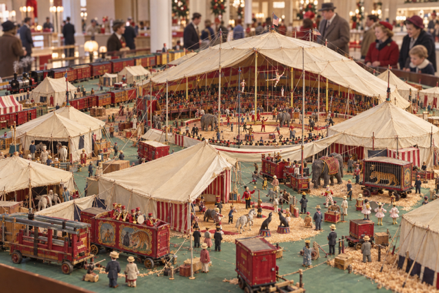
In the main lobby of the store was an enormous table that people were slowly walking around. They appeared to be studying the objects displayed upon it. I made my way through the crowd to see what had attracted so much attention. I was astonished by what I saw. Then I found myself enchanted by it, and for the first time in my life I did not want to leave a department store.
The huge table held a miniature circus, complete with a big top, ringmaster, seals, elephants, tigers, dancing dogs, clowns, trapeze artists, tightrope walkers, jugglers, dancers, bands, circus workers, and their living quarters. There were flags, people seated in the grandstands, and every imaginable detail of circus life—even the miniature trains on which the circus had arrived, complete with water buckets in case of fire. A man named Bill Brinley made it all by hand and had begun making it when he was nine years old in 1926.
Though the circus was not animated—everything stood still in a single moment—it seemed vibrantly alive, as though it might suddenly burst into motion.
I learned that it was a traveling exhibition that shopping centers could book to bring people into their stores. This exhibition certainly did that. The circus remained there for a week, and I asked my parents to take me back every day. Each time, I noticed that shoppers, young and old alike, crowded around this miniature fantasyland.
I kept asking myself: How did this young boy, then the man he became, do this? What did he use to create all these tiny likenesses?
As I looked closely, I began to see some clues. He had used empty thread spools of all sizes and modeling clay to fashion the performers and the people in the grandstands. Tiny bits of cotton became cotton candy. Finely ground glass created sparkling surfaces. He used pieces of birds’ feathers, heavy string, and cord to simulate ropes, hand-carved wood for animals, small mirrors, pieces of tin cans, jar lids, tiny rocks, carefully hand-painted miniature signs, and ground-up pencil shavings for sawdust. He also used small wooden boxes in which cheese came, and discarded bedsheets for the big tents.
His ingenuity was unlike anything I had ever seen. It was clear that the creator of this miniature world must himself have been enchanted by the circus.
But what about his enchantment inspired him to create an entire circus in miniature? He might just as well have collected circus memorabilia. He could have gathered photographs, painted pictures, created other works of art, written a book, become a circus historian, or watched old films about circuses. Instead, something compelled him to recreate the circus in a form he could hold in his hands. This fantasy began when he was a child and attended a circus with his father near his hometown. The story was that Bill told his father after seeing the circus that one day he would like to have one of his own. And he did!
Researchers have explored our fascination with miniatures, a phenomenon that is thousands of years old. They suggest a host of psychological motivations, several of which ring true to me. One is the desire to feel some sense of control when the world seems overwhelmingly large and powerful. Another is the wish to fully comprehend something. When an object is made small, you can see it from every side. Instead of being too large to grasp, it can be held in the palm of one’s hand. In Bill’s case it was a way to have something that had seemed impossible to ever own.
Miniatures can also educate us by allowing us to study the many parts of something and see how they fit together. And perhaps they satisfy our desire to decide how a world will be made, arranged, and presented.
Yet the spiritual motivations may be deeper still.
Inside each of us is something the Creator apparently placed within us at our making: the desire to create. Perhaps this desire is part of the divine image within us. We long to bring something into being, to take ownership of it, and even to feel pride in what we have made. This is the process of co-creation—creating with the Creator.
In our own way, we can stand back after making something and say, “That is good.” We imitate the color, geometry, beauty, realism, numinosity, architecture, and soul qualities found in nature and culture. This is true not only in the art of miniaturizing, but in every creative endeavor—including the profound human desire to create a family by having and raising children. For others it may mean creating a garden, a business, or a home.
And so, I imagine that the little circus stirred something deeper in me—and in the many others who gathered around it. We were not merely enchanted by what one man had created. Perhaps, for a moment, we were awakened to the Creator’s own desire within us: the longing to imagine, to fashion, and to bring something beautiful into being—something we made from our everyday lives and materials—something from us that is enchanting.
Spiritual Practice and Inquiry
What have you created from your own ingenuity, that enchanted you and others. What numinous properties of this stand out to you and why?
Prayer
Dear God, For the soul qualities that little circus touch in me even before I had the words to express it, I am thankful. For that experience joined others to show me that I too could create my own enchantment.
Amen