

Living with Uncertainty Part 5
August 29, 2026
When we are afraid and uncertain about the future, there are several things we can do to steady ourselves. We have reflected on some of them this week. Yet there is another practice—simple, immediate, and deeply healing—that can ground us, comfort us, and remind us that we are surrounded by sustaining love.
We can share our fear with another person and ask them to pray with us.
Simple as this may sound, we often resist doing it. Speaking honestly about our fears requires courage. It asks us to become vulnerable, to admit that our strength has limits and that we cannot always find our way through uncertainty alone.
Sometimes we hesitate because we fear that saying something aloud will somehow give it greater reality. We may also feel embarrassed by our anxiety, particularly when our fear seems irrational or out of proportion to the situation. We may believe that a person of faith should be stronger, calmer, or less troubled.
But fear is not necessarily a failure of faith. It is part of being human.
When we pray with a compassionate person, something important happens. The fear is no longer sealed inside our own consciousness, circling endlessly through our thoughts. It is brought into relationship. What was privately carried is now shared with someone who cares.
Recently, I was deeply uncertain about a situation, and anxiety began to creep into my life. Though I am blessed with faith and inner strength, this particular concern repeatedly invaded me almost from within. I could not simply reason it away. The thoughts and feelings made me uneasy, and my body began to respond as though danger were near.
Not all fear originates in the conscious mind. Some of it arises from our instinctual nature—the ancient biological systems designed to protect us from harm. These instincts are hardwired into the body and nervous system. They developed through the long human struggle for survival, alerting us to threats before the rational mind has fully assessed them.
When we believe that we are in danger—or that someone we love may be in jeopardy—these survival systems can move rapidly to the forefront—the heart races. The muscles tighten. The breath becomes shallow. The mind scans the future for every possible threat.
Because instinctual fear is experienced in the body, it cannot always be resolved by thought alone. We may understand intellectually that we are safe yet still feel endangered. At such times, we need more than analysis. We need an experience of safety, connection, and presence.
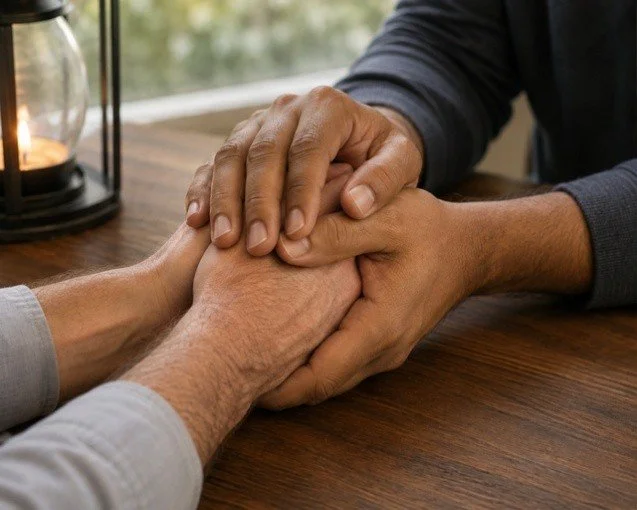
I have a dear friend who had recently endured his own period of intense anxiety. He understood how intrusive thoughts and survival fears can enter a life and temporarily overwhelm it. He knew firsthand how powerless we can feel when the body’s alarm system takes command. I asked him if he would pray with me. “Of course,” he said. We met, talked for a while, and caught up on the busyness of our lives. Then we sat down to pray. He reached across and firmly clasped my hands in his. Before he spoke a word, his touch communicated something my anxious body needed to know: You are not alone. I am here with you.
Our hands became a point of grounding. Fear had pulled me into false imagining, but his presence returned me to the reality of the moment. Together, we acknowledged that fear would not have the final word. We were turning toward a power greater than either of us. Then my friend prayed. He did not pray as someone who had figured everything out. He did not speak from spiritual superiority or offer easy assurances. How could he? He had so recently experienced incapacitating fear himself. He prayed from his humanity.
He prayed with compassion and with an intimate understanding of how fear can hijack a person’s thoughts, body, and spirit. His prayer did not deny the uncertainty of my concerns. Instead, it placed that uncertainty within a larger truth: that whatever the future might hold, we are surrounded by God’s presence and healing light. His words carried faith, but they also carried companionship. He reminded me that I did not have to manufacture courage by myself.
For me, this is one of the great gifts we can offer one another: not explanations, predictions, or promises that nothing painful will happen, but our presence. We can sit beside someone in the unknown. We can hold their hands. We can pray when they cannot find the words.
Fear isolates us. Compassion restores connection.
Uncertainty may remain, but when it is shared in prayer, its power begins to change. We discover that courage is not always something we summon from within ourselves. Sometimes strength and courage enter through the hands, voice, and faithful presence of another human being.
Spiritual Practice
The next time fear overwhelms you, invite a compassionate friend to pray with you. Let them hold your fear.
Inquiry
Why would instinctual fear be more of a challenge to overcome than the ego mind?
Prayer
Dear God, For my friend, I am so thankful.
Amen