

Thin Places Part 6
August 1, 2025
Thin Places Part 6
Sai and Nanette Mudiam took Lark and me on several pilgrimages while we were in India. Our time at the Heartfulness ashram was unforgettable because it was a thin place, as the Celts called sacred places, where the veils between heaven and earth lift. Our next holy journey in India was to the small town of Bodh Gaya. This is where Prince Siddhartha (born 563 BC) became the Buddha.
The story is that the prince, later to be the founder of Buddhism, at age 29, renounced his family and comfortable life and left his palace to see the real world and to find truth. After six years of asceticism, he gave that up and sat under the Bodhi tree (fig tree) for 49 days, or seven weeks, before attaining enlightenment at age 35.
Today, there are temples all over the area where the Bodi tree originally was. Though it is gone now, a descendant of the first tree is on the same spot and is the focus of pilgrimages. The tree is very tall, and many people sit as close to it as possible, although a fence surrounds it.
This was truly a thin spot; time seemed to drop away. All concerns seemed to disappear, and a sense of peace was everywhere, regardless of the many people. The atmosphere was charged with spiritual energy. A curious thing occurred while we were there. Many Buddhist monks were everywhere. Most walked in small groups. But I saw one saffron-clad Buddhist monk standing alone, looking outward. I wondered how he felt and from what perspective he saw life and spirit. I imagined that I would have some of the same feelings at one of our Christian holy sites in the Holy Land.
A central aspect of Buddhist practice, particularly for monks, is cultivating mindfulness (sati) and alertness (appamada), which involves being aware of everything within and without. I stood several feet behind the monk and focused on the view straight ahead, the same view he was observing. I wanted to see if I could be alert and mindful, too. Using his gaze as an inspiration, I concentrated on the back of his head to symbolically look out of his eyes to see from his perspective—the perspective of Buddha.
I sensed a beautiful spirit in him and could begin to imagine the serenity of his thoughts. After about three minutes, however, the monk sensed something, immediately turned around, looked directly at me, and left. I was astonished that he sensed my gaze from such a distance away with so many people walking between us.
It was a thin place, and the spiritual atmosphere was charged. I will never forget the monk’s apparent sensitivity to the energy coming from me toward him. The experience taught me many things, but it proved that spiritual alertness, appamada, does exist and that its energy may be even greater in thin places.
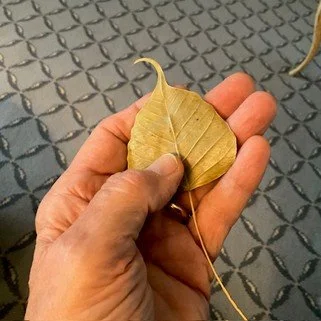
As we were leaving the temple space, a man overheard me say, “I wish I could have a leaf from the Bodi tree.” He said, “I will get one if you wait here.” He ran back to the tree and reached up to a limb that arched over the sidewalk. I now cherish my leaf from the tree of enlightenment. This place gave me many gifts.
Spiritual practice: When you go to a thin place, what are some unusual things you become alert to?
Self-inquiry: Why do you think some people can sense the presence of others?
Dear God,
Thank you for the experience at Bodh Gaya. Part of me is sorry for my intrusion into the monk’s privacy. Yet another part of me is thankful that I was fortunate to experience spiritual alertness right before my eyes. Please bless the monk who taught me so much that day. Amen