

Things People Have Told Me Part 6
August 23, 2026
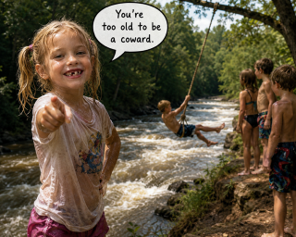
Once, a six-year-old girl said something to me that I have never forgotten.
Our family was attending a church retreat at Camp McDowell in Nauvoo, Alabama. One afternoon, I trekked with my children down to the river, crossed the swinging bridge, and followed a hidden trail high above Clear Creek.
Suddenly, we came upon a small band of children from our church. They were swinging from a rope far out over the rushing river, releasing their grip at the highest point of the arc, and plunging into the water below. Then they would swim back to shore, scramble up the steep hill, and do it all over again. We stood there amazed by their skill—and by their complete lack of concern for their own mortality. Among these fearless adventurers was six-year-old Millie.
Millie had no front teeth. She was soaking wet, bright-eyed, and seemingly indestructible. I watched as her light-as-a-feather body sailed out over the river. At the farthest point of her swing, she released the rope and dropped many feet into the water below. For a moment, she disappeared beneath the surface. I held my breath. Then her little head popped back up, and I exhaled.
Millie swam confidently to shore, climbed the hill, and returned to the high perch from which the children were swinging. She looked at me and asked, quite naturally:
“Why don’t you do it?”
I was transfixed. By then, my imagination had already conducted a complete underwater survey of Clear Creek. In my mind, the riverbed was filled with broken tree limbs, jagged rocks, rusted machinery, abandoned farm equipment, and enormous wooden spikes positioned precisely where I would land. I politely replied, “Oh, I don’t think so—today.” I added the word today to preserve a small measure of dignity. It suggested that I was not refusing outright. I was simply postponing my heroic plunge until some future occasion—perhaps when the river had been drained and the bottom carefully inspected.
But my cowardice must have shown on my face. Millie looked directly at me and delivered the words I have remembered ever since:
“You’re too old to be a coward.”
There are moments when the truth arrives through philosophers, theologians, poets, or saints. And then there are moments when it arrives through a soaking-wet six-year-old with no front teeth. What was I to do? My own children were standing there. My honor was at stake. More importantly, Millie had exposed something in me that I could no longer disguise with the word today. So… I took the rope in my hands, swallowed the fear rising in my throat, and swung out over the raging river, possibly never to be seen again, shouting:
“Be with me, Sweet Jesus!”
At the farthest point of the swing, I let go. Ker-plop! I landed in Clear Creek—alive, uninjured, and unimpaled. I surfaced, swam back to shore, and discovered that the whole thing had been easy. And fun. The children applauded from the ridge. For a brief moment, I was a hero—at least to myself.
Little Millie had unknowingly become what Macbeth lacked in Shakespeare’s play – a “spur /to prick the sides of my intent.” She became the spur that moved me beyond hesitation and into action. Without knowing it, she called forth a courage that was already present within me but had not yet been embodied. That day taught me something important about courage—and about all the virtues of the Enneagram.
In Enneagram teaching, each type has a virtue: a spiritual quality belonging to our deepest nature. The virtue is not something we must manufacture or earn. It is not foreign to us. It is already present within the soul. Yet as we become separated from our essence, we also lose conscious contact with our virtue. We begin to mistakenly believe that the very quality most deeply planted within us is the quality we do not possess.
When we lose touch with essence: Ones lose touch with serenity. Twos lose touch with humility. Threes lose touch with truthfulness. Fours lose touch with equanimity. Fives lose touch with non-attachment. Sixes lose touch with courage. Sevens lose touch with sobriety. Eights lose touch with innocence and simplicity. Nines lose touch with diligence. But losing touch with a virtue is not the same as losing the virtue itself. The virtue remains.
It waits beneath our defenses, our habits, our anxieties, and the carefully constructed explanations for why we cannot do what life is asking of us. It waits like an underground spring, ready to rise when the hardened ground of the personality is finally broken open. We often think courage means having no fear. But courage is not the absence of fear. Courage is the discovery that fear does not have the final word. Sometimes we do not discover our virtue through study or contemplation. Sometimes we discover it because life brings us to the edge of a cliff, puts a rope in our hands, and asks us whether we are willing to trust what lies within us.
At such moments, we may continue insisting that we do not possess the virtue we need. Or we may take hold of the rope. The person who awakens that virtue in us may be a teacher, a friend, a spouse, a stranger—or a small child who sees through our excuses and speaks with the unguarded authority of innocence. “You’re too old to be a coward” was not merely a challenge to swing over a river. It was an invitation to stop organizing my life around fear.
I believe there comes a time when we are all too old to be cowards—not because fear disappears with age, but because life becomes too precious to surrender any more of it to fear. We become too old to postpone serenity and love. Too old to withhold forgiveness. Too old to remain silent when truth needs a voice. Too old to refuse the life that is calling us simply because we cannot see what lies beneath the surface.
High upon some cliff in our lives, each of us will eventually be brought face-to-face with our forgotten virtue. We can turn away and continue believing that we do not own it. Or we can grasp the rope, whisper a prayer, swing out over the unknown—and discover that the virtue we were searching for has been within us all along.
Spiritual Practice
What is your virtue and how do you embody it each day?
Inquiry
List some of the ways you are in touch with your virtue.
Prayer
Dear God,
Thank you for little Millie who grew up to be a Doctor of Psychology!!!
Amen