The Parade Part 1
March 15, 2026
The Parade Part 1
Have you ever noticed how something deep inside us stirs when a parade passes by … something older than thought, something that wants to rise, to be seen, and to join the celebration?
Welcome to this week’s Daily Reflections on “The Parade.”
“Everybody loves a parade” is a familiar saying, though its origin is uncertain. Still, it captures something true. Parades awaken joy, excitement, and a sense of belonging through music, marching bands, and colorful displays. They gather people together in shared rhythm and shared meaning. And then we are in them, we have a sense of belonging and pride in the group’s combined effort. It is a chance to “strut our stuff” so to speak.
A parade is a live, moving celebration. It can honor talent, creativity, power, tradition, ideals, values, social affiliations, history, exclusive memberships, civic organizations, charities, and even mystery itself. A parade is an entertaining review of what a community holds dear enough to put on display.
My hometown of Mobile, Alabama, is known for its remarkable Mardi Gras parades; the earliest dates back to 1711, when the Boeuf Gras Society conducted it. For generations, parading societies in Mobile, and later in New Orleans, have filled the streets in the weeks leading up to Ash Wednesday, marking the threshold between celebration and the inward turn of Lent.
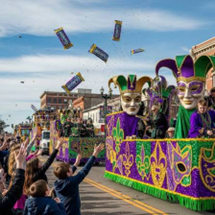
From my childhood perspective, those parades were larger than life … pure magic. I can still feel the vibration of the bass drums in my chest as the bands passed by us spectators sitting on the curb. Riders atop towering papier-mâché floats tossed candy into the crowd with exuberant generosity.
I had no knowledge when I was a child, that the parade is an institution of all human cultures and therefore is archetypal. They are an ancient language of exhibition and pride. Parades themselves reach far back into human history. As early as 2000 BC, they were associated with religious and military institutions. The Babylonians celebrated Akitu, a multi-day festival honoring the arrival of spring and the renewal of life, during which they paraded their deities and performed sacred rituals. Parades appear in every civilization, across all eras. But what mattered to me as a child was the fun, excitement, and the wonderful treats thrown to us off the floats.
At the parades, I remember reaching upward, amidst the raining confetti, to catch boxes of Cracker Jacks, rolls of paper serpentine, beaded necklaces, taffy, Moon Pies, Life Savers, Jolly Ranchers, Tootsie Rolls, and candy bars. Each one a small treasure. I looked at the marching band members, the band major, all in their colorful uniforms, with shining faces, and there were the majorettes, some with batons of fire. Some of the night parades were lit by fiery torches, and the floats were pulled by mules.
The paraders on the floats were costumed and masked. Even the law enforcement and fire departments on hand were celebrating. On Fat Tuesday, the Mardi Gras King and Queen rode their own float, complete with their page boys. The royal couple were decked out with the long trains of their royal robes stretched out behind their high papier-mâché thrones. Amazing! Around them on this float and other floats were their royal courts—knights, ladies-in-waiting, and pages.
If you have ever watched a child at a parade, you may have noticed a particular quality of excitement. It is as if they are participating in the event itself. Their eyes are captivated by the parade that becomes a vehicle for expression.
The American poet Vachel Lindsay (1879–1931) wrote in his poem “The Leaden-Eyed”:
“Let not young lives be smothered out
before they do quaint deeds
and fully flaunt their pride.”
Among the many themes this poem carries is the necessity of a particular kind of pride—not haughty, inflated, or self-aggrandizing pride, but a genuine delight in one’s own life force— in Enneagram language this is referred to as the personal essence. It is the excitement of being alive, of allowing our lives to express what that life force naturally carries. This life force is the healthy ego celebrating its existence.
Spiritual practice through self-inquiry: At a specific, quiet time devoted to reflection, ask yourself this question several times. Listen carefully—not for a quick answer, but for what arises beneath the words: Why do I need to express who I am? How do your answers change with each ask?
Prayer:
Dear God, Help me discern, with love, the difference between selfish pride and healthy pride. Amen.