Stories Part 7
May 1, 2025
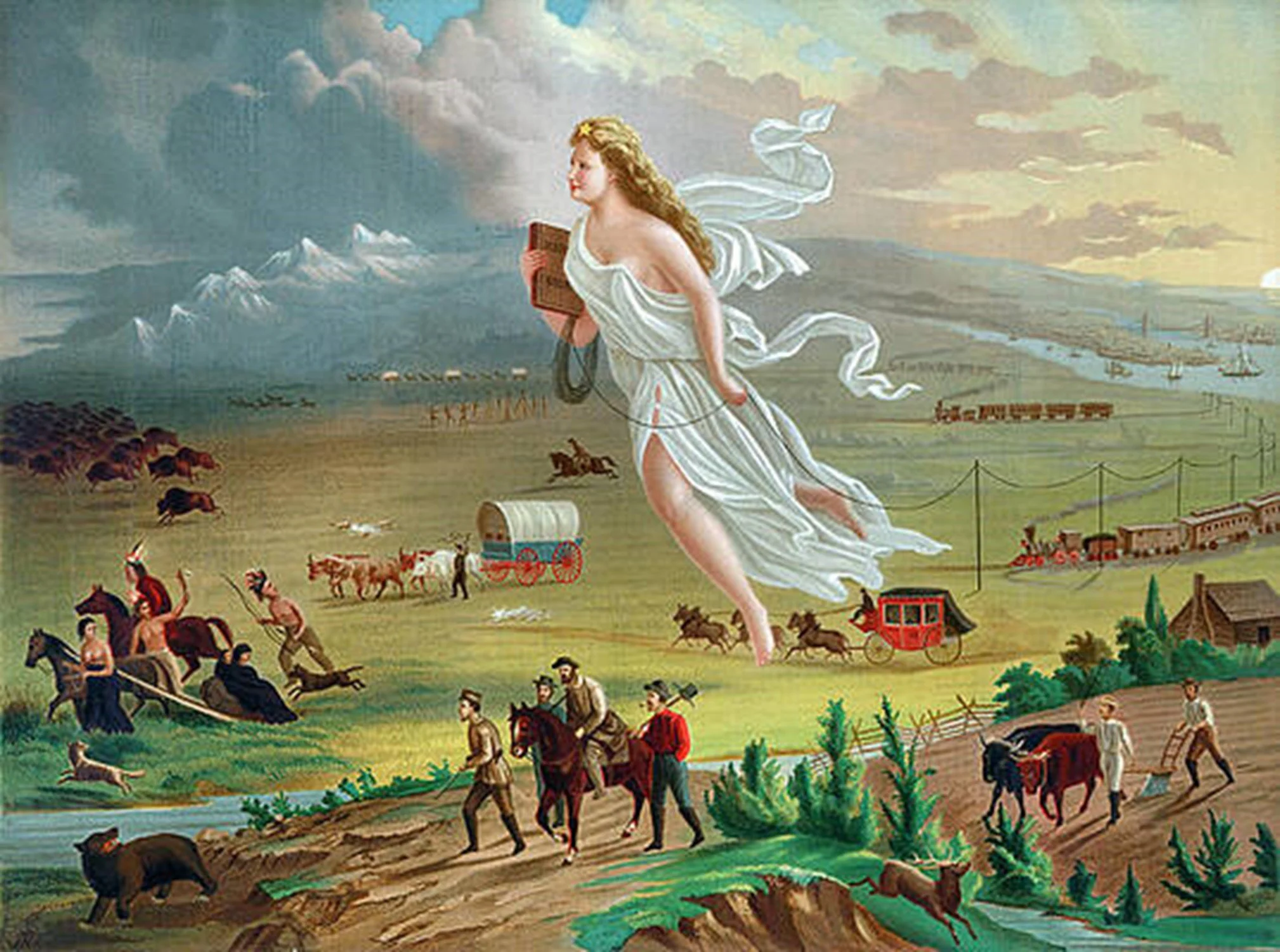
“American Progress” by John Gast, 1872, depicting Manifest Destiny.
Stories Part 7
Philosopher and Mythologist Joseph Campbell said that stories are an essential part of our individual identities, and on the macro level, they are essential to our culture. The stories we hear and tell become the myths we live by. Myths are not merely stories; they reflect the person's and society's beliefs through the use of metaphor.
In Consciousness and Enneagram studies, the story can expose, reinforce, or repulse us toward our unhealthy fixations, avoidances, and passions. For example, a Type Six story (in the form of a joke) that exposes the extremes to which the fixation of cowardice can go is: A man just inducted into the military was terrified of heights, so he was petrified of being assigned to the paratroopers. When he opened the envelope that revealed his assignment, it said “Your Assignment is: PARATROOPER.” After reading his assignment, the man’s first words were, “I knew it — the very thing I feared the most has happened to me.” On his first parachute jump, the man clutched the door with white knuckles before the sergeant pushed him out of the plane door, saying, “Close your eyes and pull the rip cord — a jeep will be down there waiting to pick you up.” Suddenly, the man was floating in the air; he closed his eyes and pulled the rip cord, but it failed. Plummeting downward in mid-air, the man said, “I knew it — my worst fear has happened again! And I bet the jeep won’t be there to pick me up, either.”
We may think the story above is only a joke, but it is a metaphor for how fear can grip us and distort our perceptions. This joke may use hyperbole, but fear can indeed prevent all happiness. Many Ego Type Sixes and others who get stuck on the unhealthy/unconscious side of Point Six experience fear this way.
And there are macro or collective myths. For example, Manifest Destiny is a myth that drove our country westward. It was glorious for those who found their destiny but disastrous for the indigenous peoples who lost theirs.
Another example of the power of myth on the collective level is a myth that the people of a particular city live by. That myth is the story upon which the city has run since its founding in the 1800s. It goes like this:
“Prosperity is homegrown, and we must protect ours. You can’t trust outsiders. They will come into our town, hijack our resources, and take over what we have built. The only way to prosper is to work within our ranks with the people we know, keep outsiders at bay unless they buy in, produce as much as possible, and ship the goods out on our trains. We trust only our city fathers; they hold the keys to our prosperity and know best; after all, they built this town.”
The city flourished under that myth for many decades. However, as the world changed and the economy broadened, growing cities were open to exchange with other entities. Even though the town struggled, the people continued to believe its myth and to discourage outside ideas. The city fathers didn’t want competition and the “riff raft” that new and larger entities would bring. The nail in the coffin was when the city fathers rejected a proposal for the new interstate highway to come through the town. They said, “A new highway would bring all sorts of riff raft that will destroy our ideal city.” So, the new highway went through a neighboring town instead. New and flourishing commerce brought unprecedented growth to the neighboring town, which eventually outgrew the struggling little city that clung to its inherited and sacred myth. Today, the city fathers have given way to new blood and city mothers have joined in leadership. What will be the city’s new myth?
In Consciousness and Enneagram studies, myth is also an inroad into our integration, virtues, and Holy Ideas. Many myths inspire hope, healing, the higher self, true nature, integrity, and kinship. These myths are not built upon passions such as fear, envy, lust, and pride. Instead, their metaphors are of the virtues and all the essential aspects of the soul: Sacred Loving Peace, Sacred Righteousness, Sacred Benevolent Compassion, Sacred Action, Sacred Creativity, Sacred Wisdom, Sacred Kinship, Sacred Joy, and Sacred Power.
It’s interesting when several conflicting myths operate in a society or an individual. For instance, those who believe in a myth built on altruism and compassion will frequently experience conflict when another myth built on self-interest is more attractive. Many of us allow both myths to exist and we choose the most convenient for any given circumstance. We rationalize our choices by saying, “There is goodness, but this is business.” But in the end one myth always overrides the others. A critical mass of a society selects the most potent myth by which the society ultimately lives… or dies.
As we have learned, the same is true for us as individuals.
Dear God,
As I discern the myths by which I live, please help me to make them compatible with my soul. Amen