Spiritual Practices Part 3
July 23, 2026
Spiritual Practices Part 3: Meditation
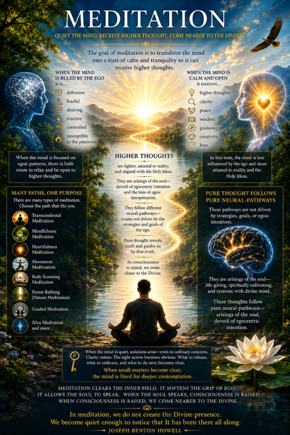
There are many forms of meditation, and the variety can feel overwhelming when we are trying to find the practice that fits us. There is transcendental meditation, Progoff's Intensive Journal method, mindfulness meditation, Heartfulness, movement meditation, the Silva Method, body scanning, forest bathing, guided meditation, and many others.
But beneath all these forms, the deeper purpose of meditation is the same: to quiet the mind so that we may become more receptive to truth.
In ordinary life, the mind is often crowded and agitated. It is easily seized by the ego—by defensiveness, fear, desire, anxiety, control, resentment, and the passions. When the mind is under the rule of the ego, it becomes reactive. It does not see clearly. It interprets reality through the narrow lens of its own myopic fixation. It is busy protecting itself, justifying itself, pursuing what it wants, and resisting what it fears.
In that condition, there is little room for openness. There is little room for wonder. There is little room for the higher movements of the soul. Meditation helps the mind become calm enough to receive what I would call higher thought.
Higher thoughts are not necessarily grand or dramatic. They may concern the smallest matter of daily life or the deepest question of the soul. What makes them higher is not their subject matter, but their source. They arise without the heavy burden of egoic energy. They are not driven by self-defense, image-making, fear, or the need to control. They are lighter, truer, more spacious, and more aligned with reality.
Such thoughts feel different because they come from a different place in us. They are not forced. They do not tighten the body; instead, they can speak through the body, its sensations, and the impressions it feels. They do not demand that we prove ourselves right. Instead, they emanate a subtle authority. They bring clarity. They bring peace.
These thoughts may be understood as arisings of the soul.
An arising of the soul is pure because it is not distorted by egocentric intention. It is not filtered through the eye of fixation. It is not trying to win, defend, impress, or possess. It simply reveals. It opens a path toward truth. It guides us by a wisdom deeper than our ordinary thinking.
This is why meditation is not simply relaxation. It is not merely a way to reduce stress, though it often does that. Meditation is a spiritual practice because it changes our relationship to the mind itself. It teaches us that we are not every thought that passes through us. We are not our fear. We are not every desire. We are not every old pattern that rises in us and claims authority. At our core, we are pure, divine nature. We begin to see that the mind can be a servant of the soul rather than a servant of the ego.
Learned spiritual guides have long taught that when the mind becomes quiet, solutions often arise naturally—even to ordinary problems. We suddenly know what to do, what not to say, whom to call, what needs to be released, or what needs to be faced. These realizations may seem simple, but they are gifts of a clearer mind.
And when the small matters of life become clearer, the mind is freer for deeper contemplation. Such contemplation is beyond thinking in words— it arises as impressions in the soul.
This is one of meditation’s great gifts. It clears the inner field. It softens the grip of ego. It allows the soul to speak. And when the soul speaks, consciousness is raised. When consciousness is raised, we come nearer to the Divine. And when we are nearer to the Divine, we are our most fulfilled selves.
Spiritual Practice
If you do not already have a favorite form of meditation, you may want to try different forms to see which may be the best for you.
Inquiry
How would you figure out if a form of meditation works for you?