Soul Qualities Part 7
March 28, 2026
Soul Qualities Part 7
Our ego says to the soul, “Step aside, I have a plan.” The soul says to the ego, “Tap on my shoulder when you’re ready for the real plan.”
Patience is a hallowed soul quality. And it has plenty of it because it constantly endures false starts and blind alleys of our egos. Our egos tend to create an image of glory when we are triumphant and an image of shame when we are defeated. But our soul knows that we truly become when, as Rudyard Kipling (1865-1936) said:
“If you can meet with Triumph and Disaster
And treat these two imposters just the same …”
(from the poem, IF by Rudyard Kipling)
Triumph carries much that is not pure victory. Winning often means a lot of responsibility and sometimes unpopularity. In triumph, we can lose sight of our ideals if we place all our energies into winning and accomplishing. And disaster is not always a total loss. Victims of natural disasters have said they became stronger and more resourceful because of the unfortunate circumstance. Disaster carries within it new possibilities, innovation, creativity, and growth.
Patience has been called long-suffering and is the virtue of waiting. John Milton (1608-1674) in his poem, “On His Blindness” has a famous last line: “They also serve who only stand and wait.” Milton hit home a profound realization that passive endurance, patience, waiting instead of gaining immediate gratification, faith can serve God as much as active, productive labor. Written after becoming totally blind, Milton concludes that even when one cannot actively work, serving God through acceptance and waiting is a form of faithful service.
But waiting and delay are things the ego usually reacts against. If our ego is tapping its foot to get its plans under way, we might remember what Milton points out: that there is virtue in waiting. The ego is desperate to arrive. But arrival is actually not a destination because what we really want is peace right now. And we receive peace in our soul in the present, not at some finish line. We cannot have peace in constant motion searching for more. We serve our souls by waiting ... in peace.
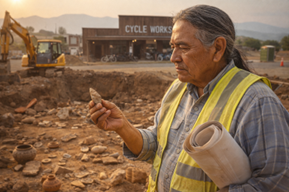
Harry, a Native American, waited for years to make a significant contribution to the world. He swore he would wait until the vision was made clear. During his life, people wondered why he was simply content to live one day at a time. But Harry kept hope in his heart. He waited and, on some days, was admittedly discouraged. But he did not waste his time ... he worked in a bicycle shop and became a good repairman. But one day in his 60s, Harry discovered a deed to some land that had been left to him. This land was unusual in that in the last few months, an ancient Native American archeological site was found on it. Harry could not believe that this land was actually his. Of course, he was passionate about Native American culture and now was in the position to sponsor numerous projects and digs. Harry’s interest brought many people to the area, and he received a grant for a cultural center where people learned about the Native American culture that thrived there from 800 A.D. to 1200 A.D. Harry’s life is an example of spiritual waiting.
As long as we are doing the spiritual work of becoming, we do not have to force anything. It comes at its appointed time.
Spiritual practice: Make a list of the things you are spiritually waiting for. Have you given up on them, or are you still waiting?
Self-inquiry: Do I serve by waiting?
Prayer:
Dear God, I ask for the gift of patience. I know that patience is the waiting room for our destiny and a way to serve You. I pray for trust in the unseen wonders that are preparing themselves now. Amen.