

Simplicity Part 5
August 8, 2026
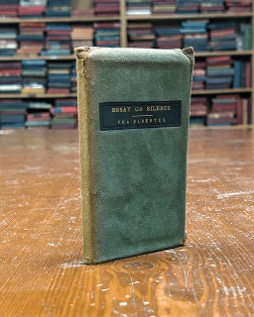
An Essay on Silence
In graduate school, I became fascinated by Elbert Hubbard (1856–1915), the influential American writer, publisher, philosopher, and leading voice in the Arts and Crafts movement.
Hubbard was an unusual character—bold, creative, independent, and often ahead of his time. His best-known work, A Message to Garcia, published in 1899, brought him international acclaim. In it, he praised responsibility, personal initiative, and the ability to carry out a task without excuses, hesitation, or endless instruction.
His philosophy gave birth to the Roycroft community in East Aurora, New York, which became an important center of the American Arts and Crafts movement. There, artisans created handcrafted furniture, metalwork, finely printed books, and beautiful bindings. Hubbard believed that useful things could also be beautiful—and that meaningful work could nourish the human spirit.
I had read several of his books, along with articles from his magazines, The Philistine and The Fra. My favorite was Elbert Hubbard’s Scrapbook, an intriguing collection of historical observations, aphorisms, essays, quotations, and drawings.
But there was one small work of Hubbard’s I could not find: An Essay on Silence. (1905)
I needed to read it for a paper I was writing for a graduate school class. Eventually, I discovered that a copy was held in the Beinecke Rare Book and Manuscript Library at Yale. Because it was rare, the book could not be checked out and carried back to my room. I had to visit the library, formally request permission to view it, and return at an appointed time.
When the hour arrived, I was escorted into a small reading room designed to protect rare manuscripts from damaging light. A librarian carefully placed the little leather-bound volume on a tilted stand before me. Then she handed me a pair of white gloves like the ones she was wearing.
“Please put these on before touching the book in any way,” she said pleasantly but firmly. Then she left me alone.
There I sat—in a special library, inside a special room, beneath special lighting, wearing special gloves—to examine a small, rare, and precious book. The atmosphere was almost sacred. I took a breath and carefully opened the cover. I studied the title page. Then, with great anticipation, I turned to the first page of the essay. It was blank. I turned the next page. It, too, was blank. I continued turning pages, slowly and carefully, expecting the essay to begin at any moment. But every page was empty. There was not one printed word in the entire book.
For a moment, I simply sat there. Then I understood. It was a perfect essay on silence. Hubbard had said everything without saying anything at all. All my preparation, all the library procedures, the protected room, the special lighting, the white gloves, and my solemn anticipation had led me to an empty page. And yet, the page was not truly empty. It contained an experience. It contained humor. It contained humility. It contained a truth that words could only have complicated.
Sometimes the deepest message is not found in an explanation. Sometimes truth arrives when explanations stop. We are accustomed to searching for more words, more information, more interpretation, and more certainty. Yet some realities can be understood only when the mind becomes quiet enough to receive them.
Silence is not merely the absence of sound. It is a presence. I felt as if I were being instructed by Hubbard at that moment. His manner of getting across the profundity of silence reached all the way from his writing in 1905 to me in 1974, without one word. And it taught me volumes in only a few seconds.
Prayer
Dear God, Thank you for the simple experiences that humble us, awaken us, and say more than words ever could. Help me not to fill every silence, explain every mystery, or clutter every empty space. Teach me to be quiet enough to recognize the wisdom already there. For that simple, humorous, and illuminating experience, I am—and will always be—grateful.
Amen