Simplicity Part 6
August 9, 2026
The Desire of the Heart
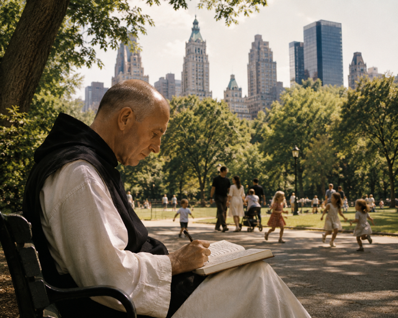
Trappist monk and theologian Thomas Merton (1915–1968) made enduring contributions to Christian spirituality, contemplation, peacemaking, and spiritual formation.
At the heart of his teaching was the discovery of the True Self—the self hidden in God. Merton believed that beneath the socially conditioned, ego-driven identity we construct, lies a deeper and more authentic self, capable of living with love, freedom, and compassion.
His writings became a beacon during the civil rights era, and he advocated what might be called the “de-cloistering” of contemplation. He believed that contemplation should not belong only to monks and nuns behind monastery walls. It should also be available to ordinary people living ordinary lives—raising families, going to work, serving communities, and facing the uncertainties of the world.
Many of you are already familiar with what has become known as The Merton Prayer. Still, it deserves our attention once again as we reflect upon the spiritual quality of simplicity. Here is an excerpt:
My Lord God,
I have no idea where I am going. I do not see the road ahead of me.
I cannot know for certain where it will end. Nor do I really know myself
and the fact that I think I am following your will
does not mean that I am actually doing so.
Excerpt from “The Merton Prayer,” Thoughts in Solitude by Thomas Merton.
When I first encountered this prayer as a young adult, I was astonished by its humility—and, most of all, by its simplicity.
Merton does not pretend to possess certainty. He does not claim to understand himself completely, to recognize God’s will perfectly, or even to know where his life is leading. He freely admits that he may be mistaken. His assumptions may fail him. His understanding may be incomplete. He may be walking in darkness without realizing it.
Yet beneath all this uncertainty lies one clear and unwavering desire: “But I believe that the desire to please you does in fact please you.”
When I first read those words, they stopped me. They simplified many things that had become complicated within me.
Like many people, I had imagined that the spiritual life depended upon getting everything right—making the right decisions, understanding God’s will, avoiding mistakes, and staying faithful at every turn. But Merton offered a more merciful possibility: God is not asking us to possess perfect knowledge. God is asking for the sincere offering of our hearts.
That does not mean that our actions are unimportant or that good intentions excuse the harm we may cause. We are responsible for listening, learning, making amends, and changing when change is needed. But our failures do not necessarily mean that we have lost our way entirely.
We may stumble. We may misunderstand. We may bumble through important moments and make error after error. Yet if our deepest desire is to love God, to serve what is good, and to become more loving toward others, that desire itself becomes a kind of inner compass.
Merton’s words remind us that faith is not certainty. Faith is trust when certainty is unavailable. It is the willingness to say, “I do not know where this road is taking me, but I will continue to walk it with an open heart.”
This desire to please God is not merely a pleasant spiritual intention. It is essential because it reveals the heart's direction. Beneath all our confusion, competing motives, fears, and ambitions, what do we most deeply desire? What is the one thing toward which our life is leaning?
Spiritual Practice
Please read Merton’s entire prayer and reflect on its meaning for you. You can find the text of Thomas Merton's famous prayer ("My Lord God, I have no idea where I am going...") on sites like Yale University Reflections and The On Being Project.
Inquiry
Why would you be or not be comfortable in telling God that you had “no idea where you are going?”
Prayer
Dear God, I am deeply grateful for Merton’s prayer. Within it, I find humility without shame, uncertainty without despair, and self-forgiveness without self-deception.
Help me to accept that I will not always know where I am going. I will not always understand your will, and I will not always choose wisely. But beneath all my confusion, may there remain a sincere desire to love you and to please you.
Gather the scattered pieces of my heart. Free me from the many fears and desires that divide me. Teach me to live in your love and to share that love with others.
When I cannot see the road ahead, help me to trust that you are still leading me. When I feel lost, remind me that I am never abandoned. And when I am afraid, help me remember that I will never face life's perils alone.
Amen