Simplicity Part 4
August 7, 2026
Everyone in the second grade had a theory about the mystery we faced each day. Our teacher, Mrs. Fell, had a glass eye.
It was brown, just like her real eye, but it did not move. It sat a little farther back, and it did not have the sparkle of her real eye that nimbly darted to see everyone and everything. Some children kept their distance from Mrs. Fell because she looked different. I liked her very much but was deeply curious about that mysterious eye.
We children often speculated about it. Had it been shot out in a hunting accident? Had a dog bitten her? Had she lost it in a fight? Maybe she had been born without an eye. Did the eye come out? Perhaps the eye was sewn in. And if it came out, could you see her brain? We discussed these possibilities on the playground and whispered about them at our desks. With no facts whatsoever, we kept adding to our questions and theories.
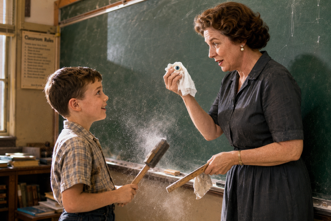
One afternoon, Mrs. Fell asked me to stay after school and help clean the blackboard. Being chosen to help the teacher felt like a great honor, though the job itself involved wet towels, dusty erasers, and more chalk powder than any human being should inhale. We washed the board and pounded the erasers with wooden rulers. Clouds of chalk dust rose around us. Soon we were both coughing, sneezing, and wiping our eyes. Mrs. Fell reached into the pocket of her dress, pulled out a handkerchief, and wiped her watering eye. Then she did something I had never seen anyone do. She removed her glass eye. I froze.
She gently cleaned it with her handkerchief, apparently unaware that my jaw had dropped nearly to the floor. When she noticed how shocked I was, she said gently, “No worries, this is my glass eye. I have had it since I was in an automobile accident when I was a teenager. It is no problem at all. I take it out every night while I sleep.” That was it—no dog attack. No gunfight. No dark family secret. No false eye sewn permanently into place. Just an automobile accident, a glass eye, and my teacher who had learned to live with both.
As she spoke, I could see the small hollow where her eye had once been. It was simply the same flesh as her face. It was not a horror, and the indentation was not open to her brain.
With two or three simple sentences, Mrs. Fell brought an end to all the conspiracy theories whispered under our breath at our desks or voiced on the playground. The mystery disappeared because she told me the truth without embarrassment, drama, or apology. I never looked at her the same way again. She had become even more real, more personal.
Thinking about the simplicity of Mrs. Fell’s truth makes me reflect on my own responses to people. I tend to worry about what to tell someone when I cannot do something they have asked of me. I may genuinely want to help, but if I cannot, I don't want to disappoint them. So, I will begin composing an explanation. Then I revise it, soften it, decorate it, and rehearse it until a simple truth begins to resemble a carefully negotiated peace treaty.
Lark will finally say, “Joe, just tell them the truth about why you cannot be there.” And she is always right. People have lives of their own. They understand commitments, limits, responsibilities, and competing priorities. Most of the time, they do not need a polished explanation. They simply need an honest one.
We often make life more complicated because we are afraid the truth will not be enough. We imagine that we must manage people’s reactions, protect ourselves from disapproval, and find exactly the right words. But a carefully manufactured explanation can create more doubt than a plain and humble truth. Simplicity does not mean saying everything. It means saying what is true without hiding behind unnecessary layers.
Mrs. Fell did not give me a long explanation about her eye. She did not defend herself. She did not act ashamed. She told me what had happened to her and showed me the truth.
And the truth did what truth so often does. It grounded me in reality; it dissolved useless theorizing. It stopped my judgments. It dissolved fear. It replaced imagination with understanding.
The simple truth and transparency can dispel mystery and speculation. And most importantly they can build trust. They remind us that we do not have to appear perfect to be accepted. We only have to be real. I am coming to understand in my soul that the simplest life is not one without wounds, limitations, or disappointments, but a life in which we no longer work to hide them.
Spiritual Practice and Inquiry
Have you ever been a “Mrs. Fell” to someone? Have you ever explained a personal limitation, wound, or defect of yours? How did it go for you? Were you understood and accepted, or did you experience other reactions from the person or persons? How did you feel when you finally made the explanation?
Prayer
Dear God, I am thankful for Mrs. Fell and that life-changing afternoon cleaning the blackboards. She amazingly gave of herself. Please enable me to do the same for others as she did for me.
Amen