

Simplicity Part 3
August 6, 2026
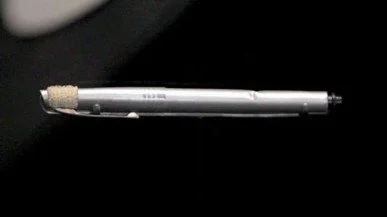
The Felt-Tip Pen
In July 1969, the world watched in astonishment as the Apollo 11 mission carried three human beings on a mission to the Moon.
After entering lunar orbit, Neil Armstrong and Buzz Aldrin climbed into the lunar module Eagle and descended toward the surface. Michael Collins remained above them, circling the Moon alone in the command module Columbia.
The landing itself was far from certain. Armstrong had to guide the Eagle beyond a crater and a field of boulders while the spacecraft’s fuel supply dwindled. Then came the words the world had been waiting to hear: “Tranquility Base here. The Eagle has landed.” Yet, landing was only half the journey. Armstrong and Aldrin still had to lift off from the Moon, reunite with Collins in lunar orbit, and begin the long voyage home. But lifting off from the Moon’s surface was a touch-and-go proposition for a good while.
After their historic walk on the lunar surface, Aldrin noticed something alarming inside the cramped cabin. The small button on a circuit breaker for the engine had broken off—probably after being struck by his bulky life-support backpack. It was a tiny piece of equipment, but without it, the normal procedure for starting the ascent engine could not be completed.
Think of it: after all the engineering, calculations, computers, fuel systems, guidance equipment, training, and human effort required to reach the Moon, the return journey depended upon one small, broken switch. Mission Control was thrown into panic. There was no backup plan for rescuing the astronauts, had they been stranded on the Moon. Houston’s biggest brains collaborated all night to plan, while Armstrong and Aldrin followed their scheduled rest period. When the time came to prepare for departure, Aldrin looked at the problem in a simple way. He said, “I need a button replacement that can trigger the switch without electrocuting me”. Then it dawned on him… he took an ordinary plastic felt-tip marker, inserted its nonconductive tip into the opening, and pressed the circuit breaker inward.
It worked.
The ascent engine was armed. The Eagle lifted from the Moon, reunited with Columbia, and the three astronauts returned safely to Earth. A felt-tip pen helped complete one of the most technologically complex journeys in human history. There is something almost sacred about that.
Engineers have the KISS principle. Philosophers have Occam’s razor. Both remind us not to add unnecessary complexity when something simpler will do. But spiritual life carries the idea even deeper: sometimes we cannot see the simple way forward because fear has made the problem larger than it is.
When we are overwhelmed, the mind multiplies possibilities. It races toward every crater, imagines every catastrophe, and peers into every black hole. We tell ourselves that we must solve everything immediately. We demand certainty before taking even one step. The problem may be real—but fear builds an entire universe around it.
The name Sea of Tranquility speaks to something in my heart. Tranquility did not mean that the lunar landscape had no craters. The craters were still there. Tranquility was the ground upon which Armstrong and Aldrin stood while surrounded by them. Life teaches me that tranquility does not require the disappearance of our difficulties either. It seems that the deeper ground within can face them. When we go into our body and anchor in the state of tranquility, we move through the world with hope.
When in a dilemma, I am tempted to stare at every possible danger. I can imagine the worst outcome and then react to it as though it has already happened. My thoughts become louder, faster, and more convincing.
But my thoughts are not the whole of me. I am not merely the frightened voice inside my head. Beneath that voice is a soul capable of stillness, wisdom, courage, and trust. There is within each of us a Sea of Tranquility—a place untouched by the turbulence passing over its surface. When I return to that place, I may not receive the complete answer. I may not be shown the entire journey home. But I may notice the felt-tip pen already within my reach.
Simplicity does not mean that every problem has an easy answer. Nor does it mean ignoring danger, denying pain, or refusing careful thought. Simplicity means clearing away the fear, assumptions, and needless complications that prevent us from seeing what is actually before us.
Often the next faithful step is smaller than we imagined.
A telephone call.
An apology.
A night’s rest.
A request for help.
A decision postponed until the heart becomes quiet.
A simple tool already in our hand.
A will to surrender everything to the Divine.
We may believe that heroic journeys require heroic solutions. Yet sometimes courage is simply the ability to remain present long enough to recognize what has already been given.
Spiritual Practice
Bring to mind a dilemma you are facing. Sit quietly and breathe slowly. Feel the support of the chair beneath you and the ground beneath your feet. Imagine yourself standing beside the Sea of Tranquility. The craters have not vanished, but they no longer fill the entire landscape. Let the stillness of that place move gently through your body, heart, and mind. Then ask:
What is actually required of me now?
What fear or assumption am I adding to this situation?
What simple, faithful step is already within my reach?
Do not force an answer. Rest with the question. Tranquility itself may be the first step toward seeing clearly.
Inquiry
Why do we sometimes prefer an immediate answer to the wisdom that comes from resting with a problem?
Prayer
Dear God,
When fear multiplies our problems, lead us back to the Sea of Tranquility within.
Quiet our racing minds. Help us see what is essential, trust what you have already placed in our hands, and take the next simple and faithful step.
For every hero’s journey, I am so grateful that you equip us with what we truly need.
Amen