Sacred Pilgrimage Part 6
April 19, 2026
Sacred Pilgrimage Part 6
Sometimes the greatest insight of a pilgrimage comes from the stranger we meet along the road.
The root of the word pilgrimage comes from the Latin word, “peregrinus” meaning foreigner, stranger, outsider, or traveler. From the very beginning, a pilgrim is someone who leaves the familiar and treks into unknown territory. Paradoxically, the unfamiliar becomes one of the pilgrim’s greatest advantages. When we step outside our usual environment, we also step outside our usual roles and identities. For a time, we are no longer defined by the expectations, routines, and assumptions that normally shape our lives. In a sense, we are not only traveling through a foreign land, we actually become “someone else.” And that new perspective gives us new eyes.
With those new eyes, curiosity awakens. The pilgrim begins to ask deeper questions: What is this? Why is it this way? What does this mean for my life and understanding of the world? The landscapes, ideas, beliefs, customs, rituals, and experiences encountered along the way do more than provide information… they reshape the pilgrim’s worldview. By the end of the journey, the pilgrim is no longer the same person who set out.
One of the most important aspects of being a stranger in a strange land is that our assumptions and preconceptions are exposed. Some call this culture shock. But for a pilgrim, it may be better understood as recalculation—a moment when our understanding of the world is adjusted and expanded. A true pilgrimage requires more than observation. The pilgrim must engage. We must listen, encounter, and interact with the people and environments around us. Otherwise, our journey becomes like traveling in an airtight compartment, seeing everything yet absorbing nothing. Transformation only occurs when we allow our experiences to challenge and reshape us.
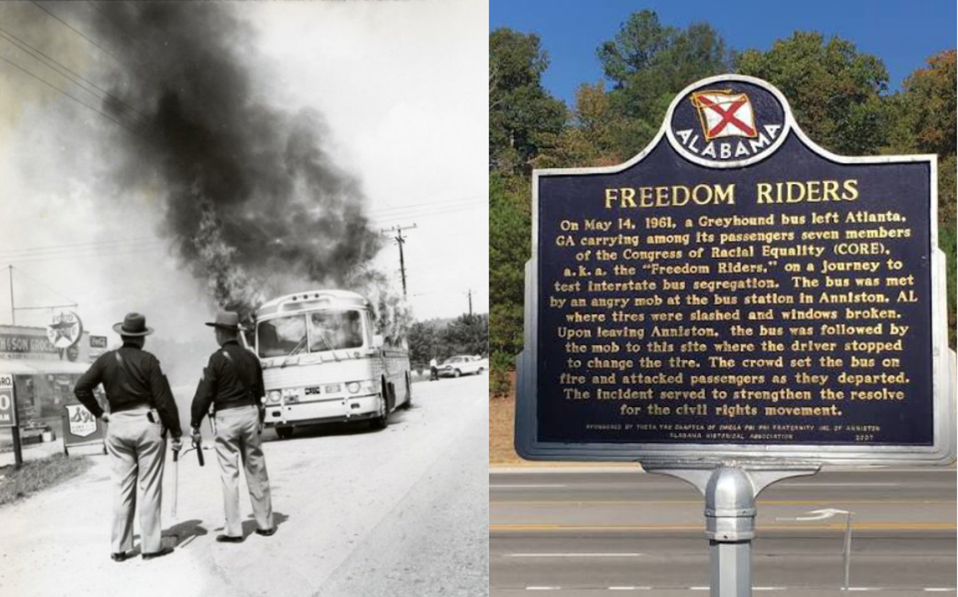
During one pilgrimage, my fellow travelers and I visited the site near Anniston, Alabama, where the bus carrying the Freedom Riders was burned in 1961. Today, it is a national historic site protected by the National Park Service. As we approached the area, we asked a local man walking along the road what he knew about the site. He replied, “Oh, that’s where the bus was burned. I was eleven years old when it happened. I lived right over there. Those people had no reason to come through here. Those outsiders got everything they deserved.”
We thanked him and continued our pilgrimage.
But what does a pilgrim do with such an encounter? How do we hold words that trouble the heart? How do we deal with the unexpected? How do we understand it? How do we allow such encounters to shape us without hardening us? This is part of the inner work that pilgrimage awakens. Encounters like this force us to see what we might otherwise avoid. And sometimes, it is precisely our role as outsiders that allows us to perceive truths that familiarity might hide.
The road of pilgrimage does not simply take us to sacred places. It takes us into sacred questions.
Spiritual practice: Recall a time when you passed through unfamiliar territory—physically, emotionally, or spiritually. Journal about what you encountered and how those experiences slowly worked their way into your understanding of the world.
Self-inquiry: What might be the hidden advantage when a pilgrimage does not go as planned?
Prayer:
Dear God, I pray for the man we met on the road. Thank you for placing him in our path, for through that encounter, we saw something we might otherwise have ignored. That pilgrimage changed our lives. May every journey open our eyes and soften our hearts. Amen.