Passing the Peace Part 6
July 5, 2026
Passing the Peace Part 6
What constitutes peacefulness for you?
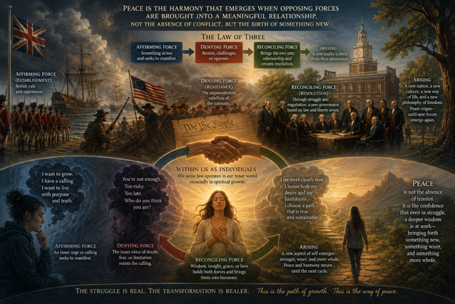
Most of us would describe peace as harmony, whether we use that word or not. Harmony is the essence of peace. It is the coming together of different elements to form a meaningful whole. Yet true harmony contains a paradox: it does not eliminate opposing forces—it includes them. One way of understanding this is through the Law of Three. According to this principle, three forces are always at work in life.
First, there is the Affirming Force—something new appears and seeks to manifest itself. Then comes the Denying Force, which resists, challenges, or limits what is trying to emerge. Finally, there is the Reconciling Force, which brings the two into relationship and creates the conditions for something new to arise. The result is an Arising—a fresh reality born from the interaction of the other three forces.
History offers many examples. The founding of the United States illustrates this dynamic. British rule represented an established force. (Affirming Force). Colonial resistance arose against it. (Denying Force). Through years of struggle, sacrifice, and negotiation, a Reconciling Force gradually emerged. The result was not simply victory for one side over another, but the birth of a new nation shaped by both rebellion and inherited traditions. A new culture, a new government, and a new understanding of liberty arose from the tension. Peace followed—not because opposing forces disappeared, but because they had been transformed into a hard-won harmony.
This suggests that peace is far more than calmness, comfort, or the absence of conflict. Peace is the harmony that emerges when opposing forces are brought into a meaningful relationship. The process itself may be anything but peaceful. At times, it can be turbulent, painful, and even chaotic. Yet beneath the turmoil, a deeper order is quietly at work.
The same principle applies within each of us, especially in our spiritual growth. We may feel an inner call to become something more—to speak our truth, forgive an old wound, pursue a dream, or follow a deeper path. This is the affirming force. Yet almost immediately another voice appears. It tells us we are unworthy, too old, too late, too different, or too ambitious. This is the denying force.
When these forces lock horns within us, we often assume something has gone wrong. But perhaps the struggle itself is part of the process. If we remain present to the tension rather than fleeing from it, a third force can emerge. Wisdom, grace, insight, or a deeper understanding reconciles the apparent opposites. Something new is born within us—a larger self that contains both forces and transcends them.
The result is an inner arising: a fresh expression of who we are becoming. For a time, harmony returns and peace settles over us. Not because all conflict has vanished, but because a deeper reconciliation has taken place.
Have you ever thought that peace is not the absence of tension after all? Perhaps peace is the inner confidence that even amid life's struggles, a reconciling force is at work—bringing forth something new, something wiser, and something whole. This is the sacred action of the Divine.
Spiritual Practice
Take a minute to “go inside” yourself to see if an affirming and denying force are locking horns. Can you distinguish these two forces and what they are intending for you? Make space for the reconciling force to land. Be aware of what spiritual alchemy creates in you.
Inquiry
Do you tend to judge yourself for having opposing forces that struggle within yourself? Or do you tend to understand that these struggles are part of the creative forces of spiritual unfoldment?
Prayer
Dear God, Grant me the awareness that my inner turmoil, if given to you, is designed to lead me to greater peace.
Amen