

Passing the Peace Part 1
June 30, 2026
Passing the Peace Part 1
You are invited to join us for this week’s Daily Reflections on “Passing the Peace.”
For me, the passing of the peace in church has always been both wondrous and, at times, awkward. To shake another person’s hand and say, “The peace of the Lord be with you.” is a beautiful gift. Yet I often wonder: to what extent do I truly offer Christ’s peace to my neighbor? Is this just a perfunctory liturgical exercise, an in-church social interaction, or a soul-to-soul encounter?
Could it be simply a warm greeting that helps everyone feel good? Or are we called to offer peace in the radical way Christ offered it? If we are, am I able to pass the peace to someone whose beliefs differ greatly from mine? To someone who has personally wounded me? What if my convictions threaten theirs? What if they feel I have trespassed against them? If we are truly to pass the peace, what does that really mean?
At the Last Supper, just before the breaking of the bread, Jesus said to his disciples: “Peace I leave with you; my peace I give to you. Not as the world gives do I give to you.” (John 14:27)
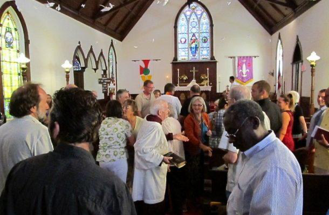
Throughout Christian liturgy worldwide, the passing of the peace that Christ first gave, remains an essential act of worship. Before Communion, the congregation confesses its sins together and receives forgiveness through the clergy person. Immediately afterward, the people are invited to share the peace of Christ. Traditionally, worshipers turn to those nearby and say, “The peace of the Lord be always with you,” with the response, “And also with you.” Some denominations pass the peace during other parts of the worship sequence that are not part of taking communion.
The practice of passing the peace is rooted not only in Jesus’ words at the Last Supper, but also in the appearance of the risen Christ, whose first words to his frightened disciples were: “Peace be with you.” The Apostles later instructed believers to greet one another with a “holy kiss,” a sign of reconciliation, unity, and holy affection.
In the early centuries of Christianity, this exchange was not symbolic alone. Believers embraced one another physically with a kiss on the cheek or lips before Communion. These outward signs signified that grievances had been released and that the congregation approached the table as one family. But are we truly one family after we pass the peace? And perhaps the deeper question is this: do we actually possess the peace of the Lord before we pass it along?
This week, we will reflect more deeply on peace and specifically the peace of Christ—what it means for us personally, relationally, and collectively, right here and right now.
Spiritual Practice and Inquiry
Drop into your heart. Do you feel the need to hold peace even toward those who threaten or oppose you? What is your theology of peace? How far are you willing to take the act of passing “the peace of the Lord”?
Prayer
Dear God, teach me about your peace, and prepare me to deepen it in the hidden places where I still reserve room for hatred.
Amen