The Miraculous Part 2
July 7, 2025
The Miraculous Part 2
Some people adhere to the dictionary definition of miraculous— “Something very unusual and out of the ordinary caused by a supernatural power.” While that is certainly true of many miracles, there are others that are not out of the ordinary. Because they occur regularly, we do not call them miracles, even though some of us ascribe them to the Divine.
In “Strawberry Moon,” a novel by John Grisham, we meet Cody Wallace, a 29-year-old death row inmate only three hours away from execution. His lawyers cannot save him, the courts turn a blind eye, and at the 11th hour, the governor grants no clemency. Cody was fourteen when he committed his crime — a break-in robbery. His accomplice, also a scared teenager, overreacted and shot the two inhabitants of the home. His brother was shot and killed by the homeowner. Cody was part of the crime, so he was indicted for first-degree murder, even though he did not pull the trigger.
It was his last hour on earth; the now mature young man who had studied and learned to read in solitary confinement, faced death by injection. “Why are they killing me?” He said to himself and the guards. “I did not kill anyone. It is all my fault.” Then, he asks his guard to take him to the prison yard to see the moon because he had not seen it since his incarceration at age fifteen.
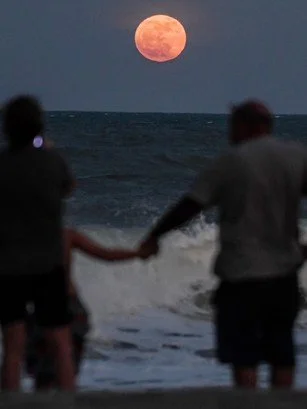
Though the guard hesitated to break the rules by allowing Cody one last look at the moon, he did, and a miracle occurred. It was June when every year a strawberry full moon appears. This night, near the summer solstice, the moon is large and reddish and seems nearer to Earth. This one last look at the moon helped this young man face an unspeakable and cruel ordeal to follow. Cody raised his pale face to the sky and got lost in the amazing moon above. Its vibrancy and otherworldliness gave this abandoned young man a glimpse into the world beyond— incomprehensible but we sometimes take its manifestations for granted. In Cody’s case, it was a miraculous moon.
Cody had been denied the human miracle of gazing at the moon for more than half his life, making his last glimpse of it a profound experience— a vital experience. The gaze helped him transcend his misery and reminded him of his earlier life when he used to look at the moon through a stolen telescope with his brother, the only person this orphan ever had or loved.
Our treasured cousin David is an Englishman. He, my brother Trevor, and I knew each other when we were all children on our visits to our mother’s homeland. We have remained close over the years. We had a lot to catch up on during my and Lark’s recent visit with David and his wife Kate, who like David, is an amazing person. When we invited them to visit us next, his remark was, “We would love to come, but we wish it to be in January or February because we do not see the sun here then. I need the sun.” David, like Cody, though for different reasons, especially loves one of the two main orbs that make this planet home. The sun may be a frequent visitor to Earth, but when it does not “appear,” we realize how much of a miracle it is.
Spiritual practice: You may not have been denied seeing the moon or the sun, but has the absence of something else caused you to realize that it is miraculous? Journal about the everyday miracles you have experienced in your life.
Self-inquiry: Why would we need to believe in miracles?
Dear God,
I thank you for the sun, rain, moon, trees, and my breath—they are miraculous to me.