

You Live and Learn Part 5
December 6, 2025
You Live and Learn Part 5
When I was nine years old, I met a set of my grandparents for the first time. It was a wondrous adventure sailing to England, my mother’s homeland, and meeting all the relatives I had only heard about. There would be hundreds of new things my brother and I would learn during the summer in and around Northumberland, with Mom and her family.
One of the many things that I learned is still a strong memory today. It was at Durham Cathedral, built over a thousand years ago. The Gothic structure, with its two shimmering towers, majestically rose above the River Wear. We picnicked on the riverbank, rented a rowboat, and paddled it up and down the river in the reflection of the great cathedral.
In the cathedral, our experienced and entertaining guide vividly described English history in a way that even children could grasp. He pointed out various architectural features of Durham Cathedral, along with graves of knights, earls, lords, ladies, and nobility of state and church. But for me, his most riveting stories were about the cathedral’s north door.
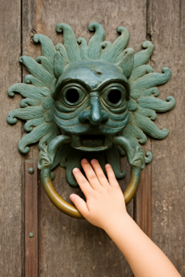
The massive wooden door had a bronze knocker in the form of a grotesque lion’s face with large dark eyes, and a semicircle striker hanging from its mouth. The monstrous face was to ward off evil. The guide said, “Fugitives who had nowhere else to hide, ran to the cathedral for sanctuary and grabbed this door knocker for dear life. The law was that no one could lay a hand on the accused if they clutched the cathedral’s imposing knocker.”
If the monks allowed the fugitive inside, their sanctuary lasted only for a period of 37 days. Many fugitives had to clutch the knocker for hours, even days before being admitted. After the 37 days, the accused would have to confess and go into voluntary exile or stand trial. This knocker still showed evidence of desperate hands that clung to it for their lives. Just think of their terror as they rapped the knockers begging for sanctuary. Murderers, burglars, cattle thieves, and horse thieves were also among the fugitives as crowds of enraged families, authorities, and angry citizens hovered around them. But according to the law, whether the pursued were guilty or innocent, they were safe as long as they clutched the knocker or were in the confines of the cathedral itself.
I grabbed the knocker’s curved striker and imagined the sheer terror of those clinging to the same worn metal I held. For a second, I pretended to be a fugitive, and the terror sent shivers up my spine.
What did I learn from this encounter? I did not realize it consciously, but I absorbed the incredible power of sanctuary for the desperate, the pursued, the guilty, and the innocent. Even a child understands the importance of mercy and safety. Even a child understands Christ’s benevolence, compassion, and sanctuary.
Spiritual practice: Recall, if you can, when you were given sanctuary. Reflect on that time. What happened to you during your time in safety?
Self-inquiry: Do you most identify with the fugitives, the monks, or the angry crowds?
Prayer:
Dear God, For all the grace, compassion, and benevolence you give me, I am so grateful. For all the grace, compassion, and benevolence given to me by dear souls, I am so thankful. You give me many sanctuaries— one of which is the temple within, where the inner critic cannot pursue me. Another is the peace that passes all understanding that your Holy Spirit gives. Another sanctuary is the community of the faithful whom you so generously provide. For all of us who need inner and outer sanctuary, I pray. Amen