Home Part 4
June 5, 2026
Home Part 4
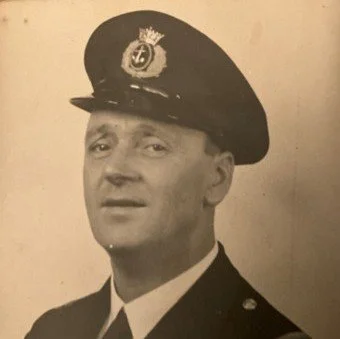
My English grandfather spent his life at sea. A merchant officer, he circled the globe through the Suez and Panama Canals, into the ports of Europe, Africa, Australia, New Zealand, South America, and India. The world was his oyster. And yet, after every voyage, he returned home.
I met him when I was nine, long after his sailing days were over. What I remember most is not the vastness of the oceans he crossed, but the intimacy of where he had landed: seated at the kitchen table in his family home in Newcastle upon Tyne, a cup of tea in hand, a coal fire burning, family gathered close. His eyes still sparkled when he told his stories, but his soul had chosen its harbor. He wasn’t going anywhere. Perhaps, in that stillness, he was reclaiming all the time he had spent away.
He once told me the sea was in his blood… that without it, he didn’t quite feel alive. I believed him. The ship, the crew, the rhythm of the tides, had become a kind of second home. And yet, even for him, the journey was never complete without a return home.
That same wanderlust did not pass to me in quite the same way. I love to travel, to see, to learn, and to be stretched by new places and perspectives. But I have never desired to live in perpetual motion. For me, the meaning of a journey is not only found in the going, but in the coming back. Because without return, there is no place to gather what has been gained—no place to make sense of it, to integrate it, to let it settle into the deeper layers of the soul. Home is where experience becomes understanding.
My home is filled with what might be called souvenirs: a miniature Eiffel Tower, a small statue of Eros, a head of Hera and a statue of Aphrodite from Athens, a seascape near Newcastle by Uncle Willie, my desk from childhood, and many paintings done by my mother. There is also a painting of the Eastern Shore of Mobile Bay, and one by my brother, Trevor, of the old Mobile Bay light house. At a glance, they are objects. But if I pause—if I really see them—they open. Each one is a doorway into memory: a street walked, a conversation shared, a moment that once lived outside of me but now lives within. These are not merely reminders of where I’ve been; they represent a piece of my soul.
And perhaps that is what a home truly is: a physical expression of the invisible life within us. When you enter someone’s home, you encounter more than décor. You encounter a life… its values, memories, longings, affections, all arranged in the space they all call home. Every object, every color, every scent, and every sound becomes a kind of language. Not just personality, but soul made visible. In this way, our homes are not static shelters. They are living reflections; they can be archival, yet they are ever-changing as we are changed... ever reflecting the emerging soul.
A souvenir by itself is like the ego. It has only a few finite dimensions. But a sacred souvenir is different. It is a transformed object, with meaning beyond its outward appearance. The object has found union with the soul. The transformed ego is like the sacred object that is one with the memory. The transformed ego amalgamates with the soul that it expresses.
Spiritual practice: Let a souvenir open to you. What is revealed?
Self-inquiry: How do you relate a transformed object to a transformed ego?
Prayer:
Dear God, For all the openings into the soul, into your infinite abundance, I give you thanks and praise. Amen