
Dr. Howell’s Reflections
Everyday, Dr. Howell writes a reflection, inquiry prompt, and a prayer.
To receive Dr. Howell’s reflections everyday in your inbox, please sign up for our mailing list using the form at the bottom of the page, and begin your journey into who God has made you to be.
Make peace with your ego and discover your true path today. The path to wholeness starts now!

Heartstrings Part 7
I first became aware of my heartstrings when I saw the film Old Yeller.
It was about a wonderful dog that grew in my heart as I watched the movie. The boy reminded me of myself and my dog, Sparkle. Oh, the hikes in the woods, the walks in the neighborhood and catching sand crabs on the beach! Travis was the boy in Old Yeller. He, too, considered his dog his friend and companion.

Heartstrings Part 6
Just think about why a child or an animal pulls on our heartstrings: we all have an innocent and helpless part of ourselves and identify with that helpless child or animal on some deep level. It could be an insurmountable struggle that we must cope with or a deficiency for which we have spent years compensating. It could be a long-held resentment or rage. It could be a loss or rejection. It could be an inability to feel joy, but we do not know why. It could be that we never found the love we had hoped for.
Heartstrings Part 5
Some Enneagram students who are not in the heart center find themselves strongly identifying with the heart center without understanding why. This is because we all have another ego type in the other two centers. For example, an Ego Type Five in the Mind Center might have Type Two as their strongest identification in the Heart Center, and perhaps a Nine, Eight, or One as their strongest identification in the Body Center.

Heartstrings Part 4
The personality types in the Heart Center are the Two, Three, and Four. These types share a profound disconnection from their own lovability.

Heartstrings Part 3
What last pulled your heartstrings? What broke through the wall that stands between us and our emotions? We all have such a wall. It is necessary in this world, where sad and heart-wrenching things happen all the time. The wall protects us from breaking down at the drop of a hat and from being emotionally incapacitated over and over in any given day. But the wall can thicken and become a barrier to our souls instead of a protection. Or the wall can be breached, flooding us with emotions.
Heartstrings Part 2
Why do we feel such empathy when we see injustice, pain, or human need? Because our heart's center of intelligence instantly tells us that something is not right. Something has gone against the human spirit or our sense of decency, sense of morality, fairness, or human dignity. The heart does not stop to analyze; it responds. In harmony with the body’s instinctive center, it brings tears, compassion, or even the urge to act. In this way, our heartstrings become part of our moral compass.
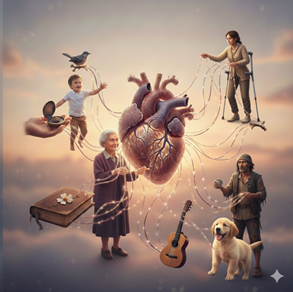
Heartstrings Part 1
Welcome to this series of Daily Reflections on Heart Strings.
You’ve likely heard this phrase used in tender moments:
“That movie pulled on my heartstrings.”
“Whenever you say you love me, it tugs on my heartstrings.”
“I saw that little puppy in the pet store, and she stirred my heartstrings.”
“When you told me of the family’s plight, it touched my heartstrings.”