Meaning-Making Part 7
March 10, 2025
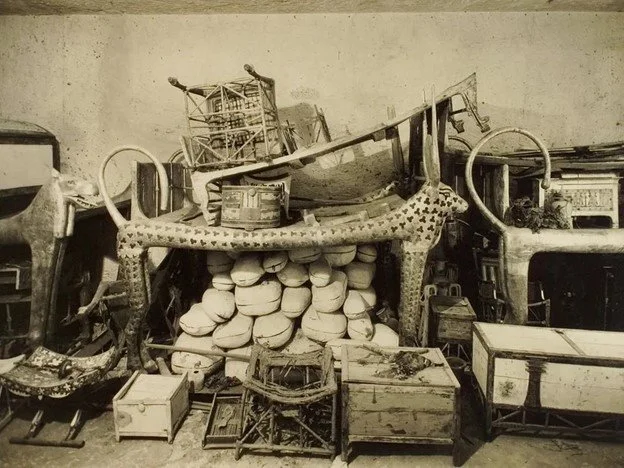
Items found in the king’s tomb. Near Cairo Egypt.
Meaning-Making Part 7
It’s very understandable when we become attached to our possessions. Many of them have profound meanings. Sometimes, we collect more and more of what we love; we may even hoard them. Some of our most meaningful possessions are not worth much monetarily, but to us, they are priceless.
When my daughter Lauren was five, she drew a picture of me at my desk at work. That portrait found a place in my heart and on my wall at work. I have favorite rocks, favorite books, and favorite knickknacks. These things are not worth much to anyone but me. I have collected stones and pebbles from around the world, but no one would know where they came from. I love little tokens that bring back memories of special people: I have some pieces of furniture that were my mother’s and father’s, and some of their things. Every day, I slip into my shoes with my dad’s shoehorn, and I have many letters my Mom wrote to me when I was away at college.
I savor these life-giving travels because they fill my heart and soul more than any material possession. Sometimes, I think about what will happen to all my treasures when I am no longer here. The ones that have no monetary value will be thrown away. Maybe when I thoroughly work out my mortality, I will do away with them myself before the estate dealers do it. Then there are the precious photos of our family. These will be priceless until my last breath. In antique shops, I often see ancient family albums; the ancient ones have great historical value.
Sometimes, I look at these albums to see the men with handlebar mustaches and the ladies with bustles and parasols. I see the children who look just like the kids we know, except they are in “old-timey costumes,” which were not old-timey when the pic was taken. It’s fascinating, but after my initial curiosity about the pictures, I get the deadening realization that these people aren’t long-lost personages in history — they are like me — with feelings and struggles.
It seems unjust somehow that pictures once so priceless are now sold for mere dollars and cents to people who care nothing about the hearts of the people in the pictures.
At an International Enneagram Association Global Conference in Cairo, Egypt, a few years ago, we saw the fantastic store of treasures that some of the kings and queens of Egypt were buried with. They had all their treasures, including chariots, clothes, furniture, horses, and servants who joined them in perpetuity. For me, their idea of taking servants and animals along with them was a stretch, but it occurred. They even took food provisions for the journey into the next world. All these things can be seen in the Cairo Museum. It seems that Egyptian royalty was not the least bit interested decluttering.
The virtue of Point Five is detachment. Given that we all make our way around the Enneagram and stop at all the points, I can identify with the greed of Point Five as well as its virtue of detachment. In one sense, we can all identify with greed and detachment because we have all felt them. If we are greedy, we can become envious and stingy. The beauty of the virtue of detachment is that we can easily detach from anything which threatens to possess us. In detachment, we are not burdened with stuff — we know the spiritual significance of everything we possess, and when we dispose of those items, we still retain the spiritual idea behind them in the treasury of our hearts and souls. When I no longer have Dad’s shoehorn or the picture Lauren drew of me, I will always imagine them in my inner being. They made indelible impressions on my soul. I believe that all the things we treasure go into our souls, and we take the spiritual essence of these things with us when we leave this world.
Self-inquiry: What will be the most challenging things to divest yourself of as life continues? Why?
Dear God,
I pray for the virtue of detachment from the physical manifestations of my prized possessions. Letting go of the physical representations of the memories and the meaning they carry, is a spiritual practice.
In your name, Amen