Greed Part 4
November 13, 2025
Greed Part 4
In becoming conscious, we awaken to the truth that we are not our appearance, personality, or possessions. We are our soul, our most authentic self, and our soul’s relationship with the Divine is the only thing we truly have, and the only thing that matters. Yet our culture tells us otherwise: “You are not enough unless you have enough.” The problem is, “enough” never arrives.
The culture of “things” turns us into targets of expert marketing, convincing us that our worth depends on what we own. This mindset makes many people rich, and it may bring happiness to many. But in its worst manifestation, it breeds greediness, and the want for more, a hunger that can never be satisfied. We are taught to seek the things that make us feel wanted, loved, admired, safe, or special. Material things and activities may give us these feelings, but they eventually dissipate and we need another purchase, object, or activity to regain the feeling of being loved and worthy. But we can never get enough of these. They never satisfy because they are only imitations of the qualities of the soul. But we still try to fill ourselves with them.
There is, however, another way to see our possessions. The entertainer Liberace, who owned countless works of art, once said, “I do not own anything. I am only a custodian of beauty created by someone else.” He understood that we leave this earth with nothing and are only temporary caretakers. His view aligns with a great virtue of the soul: non-attachment.
To love something material is not necessarily materialistic. It may stand for a loved one, a memory, or of a precious part of oneself. The object may be a work of art we admire, or an inherited family piece symbolizing our heritage. When we know that what we have does not define who we are, we can appreciate it freely. In non-attachment, (the Virtue of Point Five) we recognize that no thing or person is the source of our identity or fulfillment.
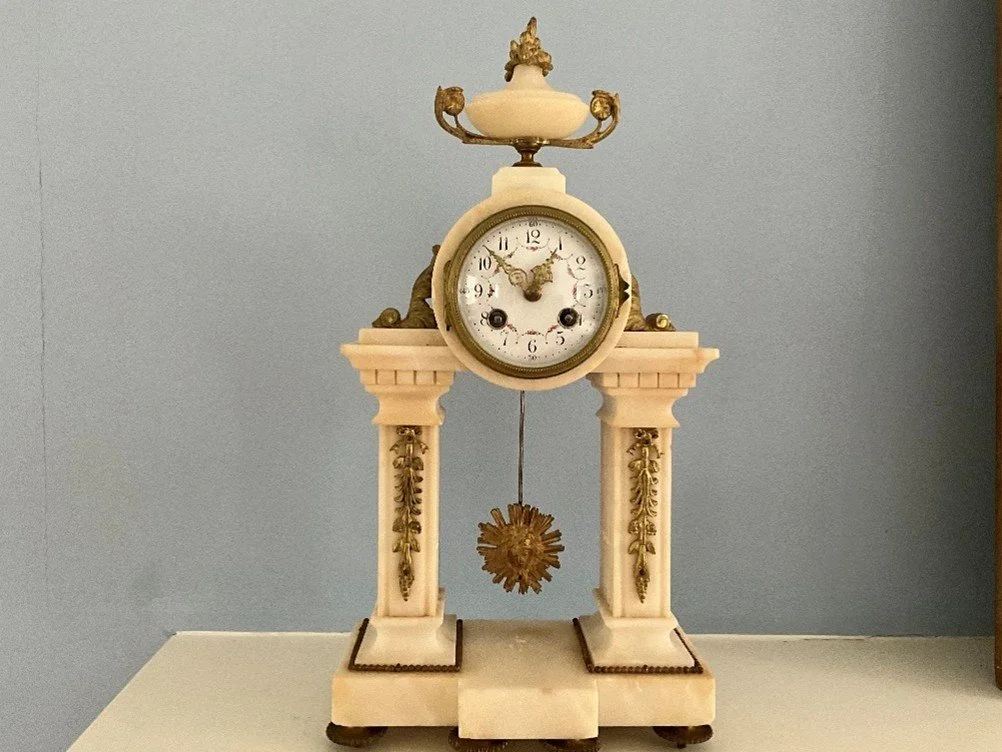
I am the custodian of a beautiful old clock. A Parisian clockmaker and artisan crafted it in the 1850’s. I bought it long ago because it reminded me of my then hero, Thomas Jefferson, who owned a similar one. I once thought it reflected who I wished to be like. But over time, I realized that no possession could give me any true quality of being. Just having the clock does not make me any wiser, kinder, innovative, or creative, the attributes I so admire in Jefferson. At best, it can only point to those qualities and cannot give me those qualities.
And if that clock is lost, the soul quality it represents for me is not. The clock no longer symbolizes my hope to have some of Jefferson’s attributes. Now, it marks how time has changed me and how time has taken things I thought I could not live without and shown me that I am still worthy and becoming. Each time I wind it, I am reminded that with or without it, I continue to evolve. And becoming is a quality of my soul that can never be lost.
Spiritual practice: Notice something someone else has that you might also desire. What part of yourself might this thing symbolize? Could it be pointing to a deeper quality of your soul that is already there?
Self-inquiry: What about greed unsettles you, and why?
Prayer:
Dear God, Keep me so rooted in your overflowing love that I never act from scarcity. Amen.