

Greed Part 1
November 10, 2025
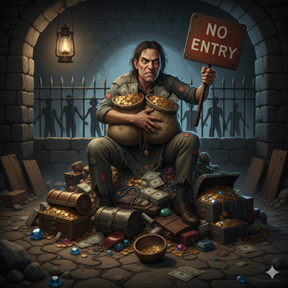
Greed Part 1
Welcome to this series of Daily Reflections on Greed.
The word “greed” comes from the Old English “grædig,” meaning “hungry” or “voracious.” It points to a hunger that is never satisfied, marked by a desire to hold on, to never run out, and to secure what we value.
In Enneagram studies, greed is associated with the ego fixation of stinginess and is connected with Point Five. Yet every personality type can struggle with this. We all pass through this territory, where fear of scarcity takes us from the natural generosity of our soul child to the withholding of our ego.
The Desert Father Evagrius of Ponticus (346–399 AD) listed greed (avarice) as one of the Nine Evil Thoughts, refined into the Seven Deadly Sins by Pope Gregory some three hundred years later. Modern mystic and scholar Oscar Ichazo developed the Enneagram of Personality and called the nine evil thoughts the “passions.” He showed how each passion distorts one of the deeper virtues. Avarice reflects a fear of lack rather than the sense of abundance and confidence we are meant to live in.
Jesus pointed to this truth in the Sermon on the Mount: “Look at the birds of the air; they do not sow or reap or store away in barns, and yet your heavenly Father feeds them. Are you not much more valuable than they?” (Matthew 6:26).
When we cling too tightly to what we have, and resist sharing it, we stop the natural flow of giving and receiving. In the collective, such greed diminishes the whole community. It is imprisoned by the fear of lack. Individual and collective healing begins when we become aware of how greed shapes our actions, how it causes selfishness and suspicion, and separates people from one another. But when we dare to trust that there is enough, and we share it, a new world of plenty opens for us.
Sometimes, however, there is actual scarcity. Take the Great Depression of the 1930s. People everywhere across the country were affected by shortages of vital commodities. My father and grandmother lived through this era and taught me that such scarcity can happen at the drop of a hat. But they said, and commentaries corroborate, that people became more interdependent and connected during that time. The flow of abundance was still felt through their reliance on one another, even if the commodities were meager compared to times before the depression. So, even in scarcity, there was the feeling of abundance for many who stayed connected.
Spiritual practice: Reflect on your own stance toward greed and avarice. What shapes your understanding—scripture, life experience, or the wisdom of interdependence?
Self-inquiry: When have you felt justified in withholding what you value? What was the cost?
Prayer:
Dear God, Give me a heart that trusts Your abundance, and a spirit that delights in giving. Amen