Spiritual Practices Part 1
September 29, 2026
Welcome to this series on “Spiritual Practices.”
What is the purpose of having a spiritual practice?
There are several reasons, but perhaps the first is this: a regular spiritual practice helps us maintain our conscious connection to the Divine. For the spiritual seeker, this connection is a priority because the Divine is our source, our support, and our true home in a world filled with distractions.
These distractions are not necessarily “bad.” Many are simply ordinary demands and attractions of life. Some may even be worthwhile and good. Yet they can quietly divert our attention from the spiritual work essential to our growth—such as cultivating wisdom, deepening emotional intelligence, and embodying the sacred qualities we are called to express in the world.
The ego is not our enemy. We need its strength, energy, and practical abilities. But when the ego is unchecked and unharnessed—when it is not in service to the soul—it can gradually move the Divine into the background of our lives.
We may still be accomplishing important things. We may be responsible, productive, admired, and even generous. But good activity is not necessarily the same as spiritual awareness. We can become so occupied with doing good that we lose our conscious connection to the Source of goodness itself. It is as if we become separate doers who act outside of divine flow.
A spiritual practice helps us return to that flow by returning our attention to the Divine. It deepens our relationship with God. It calls upon the head, heart, and body, and brings the whole of who we are into sacred presence. A spiritual practice such as this is something we engage in regularly—not merely out of obligation, but as a privilege. It is not simply a rote ritual we occasionally pull out, dust off, and perform. At its deepest, spiritual practice is our willingness to become present to the presence of God.
Over time, the practice begins to draw us toward itself. It nourishes us, steadies us, and fills us with spiritual energy. We may even begin to feel incomplete without it—not because we have become dependent upon a particular ritual, but because our soul has recognized something it needs.
Choosing a spiritual practice is deeply personal. We must consider our temperament, level of consciousness, physical condition, life circumstances, and for those of us who study the wisdom of the Enneagram, our Enneagram energies. A practice centered on outward expression, for example, may come naturally to an extrovert but feel less accessible to an introvert. A practice that speaks powerfully to someone at Enneagram Point Nine may affect someone at Point Five quite differently. Likewise, the practice that sustained us during one period of life may not be the practice we need in another.
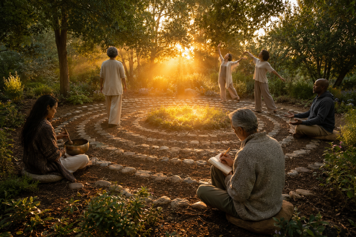
Spiritual practice has no single form. We may meditate alone or in a group. We may meditate while sitting, walking, or even running. Prayer may be spoken, sung, written, contemplated in silence, or expressed through the movement of the body. Dance, music, visual art, spiritual collage, writing, walking the labyrinth, and spending attentive time in nature can all become spiritual practices when they awaken us to the Divine. The outward form may differ, but the inward purpose remains the same: to help us become present, conscious, receptive, and available to God.
When we consider our Enneagram energies, we must be especially sensitive to the characteristics of our ego’s avoidance, trap, passion, fixation, virtue, and Holy Idea. A meaningful spiritual practice recognizes both the ego's limitations and its sacred potential. Yet our spiritual development does not end with improving the ego. We are being drawn toward our soul (Soul Point) and toward qualities that do not arise from the ego’s familiar patterns. These are qualities of our original nature. As they awaken within us, we become more fully ourselves and more consciously at one with God.
The spiritual practice most suited to us will therefore do more than comfort or calm us. At times, it will challenge us. It will reveal where the ego has taken charge, loosen our attachment to familiar patterns, and create space for the ego to come under the soul's loving leadership.
At the Institute for Conscious Being, we present many spiritual practices taught by experienced practitioners. From time to time, we are honored to welcome Heartfulness meditation practitioner Bharathi Chakravarthi. The Reverend Lori Miller-Price teaches the powerful practice of singing bowls, and the Reverend Nan Hornsby teaches dance and writing as a spiritual practice.
We have welcomed Kate Finlayson, author of Dancing the Enneagram: A Playbook. Our own Diane Wood teaches spiritual collage and walking the labyrinth, while Roger Conville teaches walking meditation. Lark Howell, Barbara Sloan, and Nanette Mudiam teach writing as a spiritual practice. Our music team— composed of Tyler Currier, Melanie Rodgers, and Maggie Banger—demonstrates music as a spiritual practice. Erika Jobes teaches a meditation method incorporating visualization, and Sai Mudiam and Rev. Tom Miller-Price teach the spiritual practice of “The Living Enneagram.” Dr. Jacqueline Morgan teaches how to listen to the words of the distinct types, to understand and to love all people more.
Each practice offers a different doorway. No single doorway is meant for everyone, and no single practice must serve us throughout our entire lives.
Discovering the practices that are best for us is often a matter of exploration, discernment, and trial and error. But the true test is not whether a practice is impressive, popular, or easy.
The test is this:
Does this practice enliven and awaken me?
Does it bring me into the present moment?
Does it give me peace while also calling me to grow?
Does it make me more compassionate, more conscious, and more available to others?
Does it strengthen my connection to the Divine within me—and help me recognize the Divine within everyone else?
A true spiritual practice does not take us away from life. It returns us to life more awake. It does not make us feel spiritually superior. It makes us more humble, loving, and whole.
The practice itself is not the destination. It is the doorway through which we repeatedly enter the sacred presence that has been waiting for us all along.
Spiritual Practice
Consider the spiritual practices in your life. Which ones awaken you and draw you closer to the Divine? Which ones have become merely habitual? Is there a practice you are being invited to begin—or perhaps to begin again?
Inquiry
What spiritual practice is calling to your soul at this time in your life?
Prayer
Dear God,
For the magnificent ways You draw us closer to You, I am forever grateful. Help me recognize the practices that awaken my soul, bring my ego into sacred service, and make me more fully present to You and to all whom I encounter.
Amen