November 25, 2026
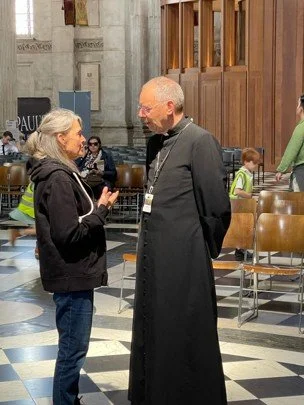
Ruthie Bresson and Priest at St. Paul’s Cathedral, London
Photo: Katherine Betts
Although one of our greatest projects in life is managing our own lives, and our purpose includes the growth of our souls, we cannot live the spiritual life focused only on ourselves. We must also be conscious of others. But being conscious of others means more than noticing them; it means caring for them.
Concern for others frees us from a narrow focus on self—a focus that directs our life force solely toward our own concerns. That perspective separates us from others and distances us from our natural state of oneness with the world—with all that is. Oneness among people and all creation is a vital spiritual quality. It helps us recognize our divinity because we understand that we and everyone else are part of the divine universe. We come to understand that we do not live in a dualistic universe, but a nondual one. What disrupts our sense of oneness and creates separation and fragmentation is the ego’s separation from the whole— its need to follow its narrative without being involved in the common narrative—the story of God. The ego can be caught up in the belief that we and those we love are the most important people in the world.
Of course, we must love those closest to us. We must protect them and delight in them through the intimate ways we share with these special souls. And we must love ourselves. But if we believe we can grow spiritually without investing in the lives and causes of people beyond ourselves and our circle, we are mistaken. Connecting with people of different backgrounds, beliefs, experiences, ages, and stations in life helps us affirm our oneness with all.
True concern for others means taking a genuine interest in their lives—not out of simple curiosity, but through an investment in their well-being. It means seeing another person not merely as a person, but as a soul—a soul whose happiness, contentment, and freedom from pain matter to us.
When I was a student, during one of my regular lunches with Henri Nouwen, we discussed what distinguishes someone who loves their neighbor from someone who really loves their neighbor. Henri looked at me and said he knew the answer. He had seen it in the way people related to his sister, who had an intellectual disability. He said, “Some people showed affection and offered kind wishes.” Then he said, “But the people who really cared for my sister took time to sit with her, play with her, laugh with her, and be with her even when she was out of sorts.” He added that those who truly cared for her were not necessarily family members who might feel a natural love for her. They were also people outside the family who chose to love and care for her. He added that caring for others is what weaves us together and what keeps the world from falling apart.
This kind of care connects us to our oneness with the universe. When our heart touches the heart of another, we realize that there is something we have in common with them though they may be nothing like us. Our differences fade away, and we see how we are in each other. The unchecked ego has little room for investing in others that way.
Inquiry
What would inspire you to care for someone outside your inner circle? What might you have to overcome in order to do it?
Prayer
Dear God,
Create in me a heart that reaches out and cares for those who seem to be nothing like me.
Amen