Thin Places Part 2
July 28, 2025
Thin Places Part 2
A thin place is where the veils that cover their numinous qualities are transparent or gone.
As we reflected on yesterday, a "thin place" is a concept primarily used in Celtic Christian traditions. It refers to geographical locations, times, or movements in which the veils between heaven and earth are thinner or lifted. Thin places allow an awareness of the transcendent Divine obscured by the ego and distractions. A thin place gives us more access to the Divine within and without ourselves.
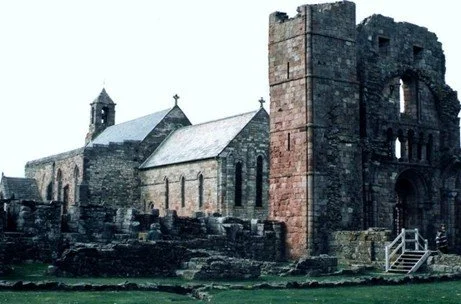
One of the most well-known thin places is Lindisfarne Island, just off the coast of Northumberland, UK. As a boy, I along with my mother and brother, visited the mile-long island, Holy Island, several times with my English grandmother and aunt, who lived in Northumberland. My first experience there was at nine years old. Neither my grandmother nor aunt ever used the words “thin place” as I remember — I only knew it was a special place because of the feeling I had there.
Holy Island was settled as a monastic community in 635 AD by Saint Aidan and his monks from Ireland. After him, the leader was St. Cuthbert, who performed miracles and whose body, buried in Durham Cathedral, is incorruptible. The priory is in ruins now, but an ancient church still exists. The year-round population of Lindisfarne Island is around 160 people.
In the 1990s, Mom was in her eighties. Lark and I, along with my brother Trevor and Karen, his wonderful wife, took Mom back to her hometown of Newcastle and to nearby Holy Island. We drove the 3-mile-long causeway in the North Sea to the tidal island. Before making the trip, we consulted the tide tables in the local newspaper, because at times the causeway is covered by the North Sea. Twice daily, at a particular time two hours before the highest point of the tide and three hours after it, can be unsafe or impossible to drive the causeway. The times the sea covers the road vary depending on the height of the specific tides, atmospheric pressures, weather conditions, and other factors.
On the island, we revisited the parish church of St. Mary the Virgin, the oldest building. It includes sections dating back to the Saxon period, such as a Saxon arch. The church is on the site of the wooden church built by St. Aidan in AD 635. This church has a sacred atmosphere.
I asked the petite lady in the church gift shop how it was being a native of the island. She replied, “I am not a native of the island. Three years ago, I was the CEO of a large tech company in Manchester and came here on a holiday. My visit transformed me —I did not want to leave here because I had never felt such peace. So, I gave up my job at the company and came here to live. The people here live by a different time than people elsewhere; they are attuned to the elements. No native of this island, not even the children, must consult the tide tables to leave and return to the island—that wisdom is in their DNA. For thousands of years, natives have lived in the rhythm of the tides that are controlled by the moon. Joining that rhythm, including the Eucharist given three times daily in this ancient church, has brought me peace and made me well.”
Spiritual practice: What spiritual practice connects you to the rhythm of the universe?
Self-inquiry: If you met the lady quoted in this memory, what would you most like to ask her?
Dear God,
I pray for connection to your Divine rhythm. Amen