Meditation Part 1
November 24, 2025
Meditation as a Spiritual Practice Part 1
Please join us for this week’s Reflections on “Meditation as a Spiritual Practice.”
A hypnotist takes us into a trance by inviting us to focus on one thing such as her voice or a pendulum she swings before our eyes. In a trance, the mind is “blank,” and therefore highly suggestible. In a trance state the ego is not engaged. Therefore, the mind is more likely to think or do as the hypnotist instructs. The person under hypnosis has a new reality.
David Spiegel, MD, professor of psychiatry and behavioral sciences at Stanford University, estimates that about 25% of people cannot be hypnotized. While the exact number cannot truly be known, various percentages are frequently considered. Spiegel and his team used MRI (magnetic resonance imaging) scans to try to figure out why some people were more susceptible than others. They discovered that people who were more likely to be hypnotized show more activity in areas of the brain concerned with executive control and attention. To be open to the hypnotist one must give their internal consent and believe in the one who is making the suggestions (the hypnotist). Control and attention are conducted in the frontal lobe, and particularly in the prefrontal cortex.
Spiritually based meditation is not hypnosis or even self-hypnosis, but it uses the prefrontal cortex to stay in the condition of openness. In meditation, the brain is a blank screen and open to all kinds of messages, sensations, impressions, and insights that we cannot have when the ego is guiding, judging, and controlling most of our thoughts. In a sense, meditation, like hypnosis, requires openness, trust, and the relinquishment of directing attention.
First and foremost, spiritual meditation is not hypnosis but a restful mind-expanding state that increases our receptivity to the timeless, to altered impressions of reality, to sensation, memory, imagination, and much more. But it takes openness and trust. It is referred to as the Fourth State of Consciousness. First is the waking state, next is the dream state, next is deep sleep, and the fourth is Turiya or the meditative, super consciousness state.
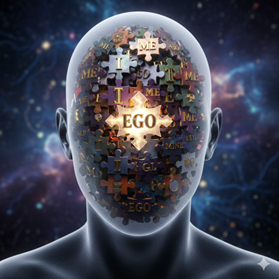
Why, for so many, is meditation an important aspect of spiritual practice? Because of meditation spaciousness. Yes, in our world of hypervigilance and increased information, the ego jams in its thoughts like a tightly fit jigsaw puzzle. But meditation opens the mind and our thoughts to become like clouds passing in the sky or boats flowing past us on a river. Spaciousness allows the spirit to enter. And spaciousness in our conscious life frees us from the oppression of the ego and superego.
Ego thoughts can intrude into our meditative state, but as we practice, our ability to tap into the divine flow increases. In this condition the things that come to us are linked to our higher self, our soul, which is tethered to the Divine.
Spiritual practice: Go into a meditative state to see what it is like for you. There are many apps you can use for meditation. One immensely powerful app is that of Heartfulness which provides explicit directions as well as relaxation exercises.
Self-inquiry: Do you experience your mind more like a tightly fitting puzzle or an open sky?
Prayer:
Dear God, I wondered why I feel so peaceful looking at the clouds, especially while lying on my back in the grass. Now I know. Amen.