Touching Another’s Soul Part 5
August 15, 2026
The Letter That Can Still Be Delivered
Yesterday, we reflected on how to touch another person’s soul through the sacred letter. Today, we will take that practice one step further and consider how a sacred letter may be written to someone who is no longer living in this world. Death may end a conversation, but it does not always end a relationship.
There may still be love left unspoken, forgiveness left unoffered, gratitude left unexpressed, and wounds that have never been allowed to heal. The person may be gone from our sight, but the bond remains alive within the soul.
During her childhood, Jan had been very close to her father. He was her protector, and as she grew older, he became her closest confidant. But during the final years of his life, family turmoil arose. An older sister insisted that their father come to live with her and gradually gained control over many of the decisions concerning his care.
Jan wanted her father to live in her own home, but her circumstances made that nearly impossible. Her husband was struggling with serious health problems, and her teenage son was having behavioral difficulties. Overwhelmed and uncertain of what else she could do, Jan finally gave in to her sister’s demands.
Her father was deeply unhappy in his new surroundings. His physical health declined, and his emotional condition deteriorated rapidly. Whenever Jan visited, he pleaded with her to take him home with her. She had to tell him no.
Instead, she made long, frequent visits, spending as much time with him as she could. But the negativity in the household became more than the older man could bear, and eventually he suffered a nervous breakdown. During one of his hospitalizations, overcome by rage and despair, he turned to Jan and said:
“I did everything for you, and you turned me over to people who didn’t give a damn about me. You are no daughter of mine.” Those words entered Jan’s heart like a blade. Her father later died, but the words did not die with him. Several years after his death, Jan came to my office. Her grief, anger, guilt, and regret had become a nervous condition of her own. She could not sleep. She was losing interest in life. She had carried her father’s final accusation for so long that it had begun to define her. This was unfinished business of the soul.
After several sessions, I felt she was ready for a couple of questions that had been forming in my mind since first hearing her story. “Do you want your father’s forgiveness?” I asked. “And do you want to forgive him?” Jan looked at me as though the question made no sense. “What difference would it make now?” she replied. “Daddy is dead.” We talked about the soul and about the possibility that love may be larger than the boundaries of physical life. Whether one understands this spiritually, psychologically, or symbolically, the soul often needs to complete what circumstances left unfinished. I suggested that she write a sacred letter from her heart, to her father.
When Jan brought the letter to my office, I will never forget the change in her. Her face appeared lighter. Her shoulders were no longer drawn tightly toward her chest. For the first time since I had known her, she wore a broad and peaceful smile. The letter was a tribute to her father. She thanked him for protecting her, loving her, and providing for her throughout her life. She asked his forgiveness for not insisting that he live with her. She told him of the countless regrets she had carried and of the ways she had replayed those final years in her mind.
Then she wrote that she forgave him unconditionally for the cruel words he had spoken in the hospital. She wrote that she understood those words had come from his fear, confusion, and suffering. She told him that, in her soul, she knew he had not truly meant them. When she finished reading the letter aloud, she held it in her hands and said, “I wish I could put a stamp on this and mail it to him.” “You cannot mail it,” I replied, “but you can make sure it is delivered.” “How?” she asked.
The following week, we arranged to meet at her father’s grave several miles away.
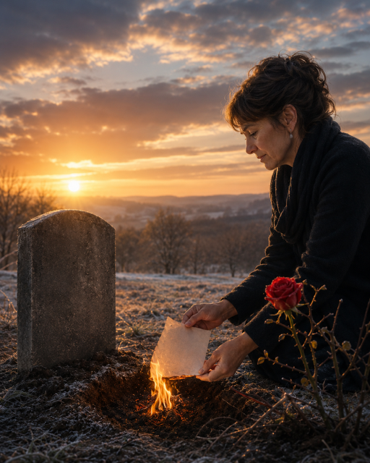
It was a cold winter day. Jan knelt beside his marker and dug a small hole in the frozen earth. She burned the letter, gathered the ashes, and gently placed them into the soil. Then she covered them with the earth, and we said a prayer. The letter had been delivered.
When Jan stood, she noticed something unexpected. Growing on a scraggly rosebush near her father’s grave was a single red rose—fully opened, despite the cold of winter. Jan picked the rose carefully. With tears in her eyes, she called it a sign that her daddy understood everything now.
Perhaps the rose was a miracle. Perhaps it was simply a rose that had somehow survived the winter. But sacred signs do not always depend upon how others explain them. Their meaning lies in what they awaken within the soul. The letter did not change the past. It did not erase the suffering or make every decision right. But it changed the place the past occupied within Jan. She no longer carried her father’s words as a sentence against her. She carried the rose instead.
There are times when we must speak to those who are no longer physically present. Apologies still need to be made, gratitude still needs to be offered, and forgiveness still needs to be given and received. The dead may be beyond the reach of our hands, but not beyond the reach of our soul’s love. And sometimes, when a letter is written from the deepest place within us, we may trust that the letter has been received—and remain open to whatever answer brings healing to our own soul.
Spiritual Practice
Is there someone no longer in this plane of existence with whom you would like to take care of some unfinished business? Try using the sacred letter as a way to heal that which must be healed.
Inquiry
If your soul consciousness remained after your physical death, would you welcome a healing letter from someone living, or would you think it unnecessary?
Prayer
Dear God, For Jan’s persistence and resilience, I give you thanks. For her spiritual trust in divine healing, I honor you. And for the sign she received, I am humbled.
Amen