Things People Have Told Me Part 3
August 20, 2026
Forgiveness does not require us to pretend that no harm was done.
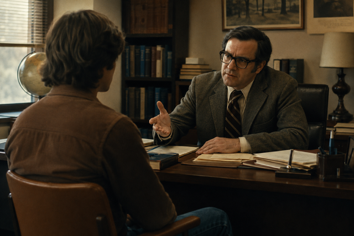
During my first months in graduate school, I had a professor whose role was to advocate for students. He functioned rather like an academic counselor—a person with whom we could consult when uncertain about our studies, progress, or the direction of our lives. At twenty-one, I needed such a person.
I had begun to realize that I was not learning what I had hoped to learn. The curriculum did not seem aligned with my deepest interests, and I was beginning to wonder whether I had chosen the right field of study—or even the right graduate school. I was not looking for someone to decide for me. I simply needed a thoughtful person to help me examine my questions honestly.
So, I confided in this professor. Instead of listening to me, the professor looked at me and said: “You do not compare well with your peers.” I was stunned.
This man scarcely knew me. He had made little effort to understand my abilities, my interests, or the kind of work toward which I felt drawn. He did not ask what I hoped to learn or what seemed absent from my education. He did not explore whether my dissatisfaction might be a sign of failure—or perhaps a sign that I was being called in another direction.
He simply compared me with others and found me wanting. I will never forget his name: Professor Hand. Looking back, I sometimes think that when I needed a helping hand, he gave me a backhand instead.
The remark was unlike anything I had previously encountered in education. It did not challenge me constructively. It diminished me. It was not designed to illuminate my predicament but to silence it. What might have become a meaningful conversation about vocation was reduced to a judgment about comparison.
Years later, I came to understand his statement as a form of verbal mistreatment. At twenty-one, I would never have placed the words professor and verbal abuse in the same sentence. Professors were authorities. I assumed they understood more than I did—not only about their subjects, but perhaps about me.
That is one of the vulnerabilities of youth: we sometimes grant authority figures more knowledge of our souls than they actually possess.
For days after that meeting, I was deeply discouraged. I questioned my intelligence, my competence, and even my worth. Had I accepted his judgment as truth, I might have withdrawn from graduate school. More tragically, I might have withdrawn from parts of my own life—from my curiosity, my calling, and the dreams that were still struggling to take shape within me.
But somewhere beneath the hurt, another voice spoke. It said, He is wrong. That quiet inner knowing proved stronger than his judgment. His words wounded me, but they also awakened me. They forced me to take my dissatisfaction seriously, to search for a curriculum that matched my interests, and eventually to find an educational setting in which I could flourish.
What was intended—or at least received—as dismissal became a catalyst. Some things people tell us remain in memory like splinters. We remember them with anger, humiliation, or shame. But over time, even a painful statement may be understood differently. It need not remain only the scene of an injury. It may also become the place where something in us stood up, became conscious, and refused to surrender.
This does not mean that cruel words are secretly good or that harmful behavior should be excused. Words have consequences, and those who hold positions of authority bear a particular responsibility for how they use them. But spiritual maturity gives us the freedom to decide what another person’s words will ultimately mean in our lives.
We may not be able to erase the original voice, but we can provide a new voice-over. We can say: That judgment was not the truth about me. It was the expression of another person’s limitation, unconsciousness, or unresolved pain. And then we may ask: What did the experience awaken in me? Where did it redirect me? What strength did I discover because I was forced to defend something sacred within myself?
Forgiveness does not require us to pretend that no harm was done. It means we no longer allow the harm to have the final word. We see the one who injured us not only as an offender, but as a human being acting at that time from an unconscious place. We may even come to regard the act as pitiable rather than powerful. Professor Hand’s words could have closed a door in me. Instead, they sent me searching for another door.
In the end, his backhand became a helping hand because the soul possesses a mysterious capacity to transform even an insult into direction, an injury into insight, and rejection into the beginning of a truer life.
Spiritual Practice and Inquiry
Is there something someone said to you that may need to be voiced over so that it no longer evokes a negative feeling but a productive action?
Prayer
Dear God,
I lift up to you in forgiveness, Professor Hand, and his misspoken words to me. May these words always be remembered by me as being, in the end, a helping hand instead of words of shame.
Amen