Spiritual Practices Part 3
October 1, 2026
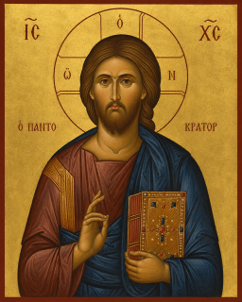
Some spiritual practices require a chapel, a retreat center, or a long stretch of silence. But others can be done almost anywhere. One of the most ancient practices is the practice of prayerful gazing—looking deeply at a sacred symbol until it becomes more than something we see. It becomes something that sees us.
My dear friend, the Reverend Robert Childers, has taught me many things over the years, and one spiritual practice has always been special to me: gazing at an icon.
For Robert, praying before an icon was not simply an act of looking at religious art. It was a way to enter into a deeper closeness with the Divine. The icon of Saint Francis of Assisi pictured with this reflection, painted by iconographer, Jane Wood, of Anniston, Alabama, is an example of the kind of sacred image Robert uses to enter that holy stillness. The other icon is well-known from the Eastern Orthodox Church.
The practice is simple but takes us beyond a trance into inner terrain that we could enter only by such an altered state of awareness. First, we find a place to be alone. Then we light a candle and allow ourselves to become quiet. Then we turn our attention to the icon. We begin at the edges, slowly letting our eyes move inward, toward the center. We do not rush. We do not analyze. We behold. Then, gently, we lift our attention to Christ's eyes or the saint who is the subject of the icon. And something begins to change.
As we lose ourselves in the eyes, our perception shifts. We do not lose consciousness; we gain it. The mind becomes more spacious. The heart becomes more available. Profound things may enter our awareness—even if they appear at first to be ordinary things. A memory. A fear. A longing. A truth we have avoided. A mercy we did not know we needed. Then we realize that something more is happening than our looking. Christ or the saint is looking back.
In that gaze, we are seen as we are—without pretense, without hiding, without decoration. The defended self begins to melt away. The anxious mind begins to rest. The soul realizes it does not have to perform to be loved. In the eyes of Christ, or the saints, we are exposed but not shamed. Known, but not rejected. Seen, and still held.
This practice can be especially powerful in times of discernment, fear, anxiety, uncertainty, or spiritual blockage. Many years ago, when I was a young father and professional, I was going through a particularly difficult time. I was troubled and uncertain, and I talked with Robert about it. That was when he showed me the spiritual practice of icon gazing.
“It will redirect you and lift you up,” he said.
So, we gazed at one of his personal icons together. We prayed. Then I did it on my own. It was powerful.
I will never forget the peace that came to me in the midst of that turmoil. Nothing outside me changed immediately, but something inside me was steadied. I was no longer alone with my fear. I had been lifted into a larger presence.
When we pray before an icon of Christ or the saints, the gaze becomes relational. We are not simply looking at an image. That frontal gaze is part of the spiritual power of these icons. Orthodox theologian John Chryssavgis writes that Orthodox icons often present faces frontally, so the eyes of Christ or the saints meet the beholder. He connects this to the wisdom of the Desert Fathers, who spoke of the heart becoming “all eyes.”
What a striking image: the heart becoming all eyes.
I believe that this is what happens in prayer. We begin by looking with our physical eyes, but slowly the heart learns to see. And when the heart sees, it does not see as the ego sees. It sees with tenderness. It sees with truth. It sees with love.
The power of icon gazing is available to anyone who wishes to try it. We need only become still, behold the face before us, and allow ourselves to be beheld.
Spiritual Practice
Follow the steps above. Sit quietly before the icon of Christ or a saint. Let your eyes move slowly from the edges toward the center. Then rest your gaze on Christ's eyes and face. Stay there. Let yourself look and let yourself be looked upon.
Inquiry
What was your experience of gazing into the eyes and face? What did you notice in your body, your heart, your thoughts, or your spirit?
Prayer
Dear God,
See me. And let me see You.
Amen